
Detailed and Updated Maps of Mt.Everest and Everest Base Camp Tourist Routes
Mount Everest, the highest mountain in the world at 8,848.86 meters, is one of the world’s most iconic travel destinations. Every year, travelers from around the world visit Mount Everest to experience its breathtaking scenery and explore different Everest Base Camp tour routes from Tibet and Nepal.
There are several Everest Base Camp tour routes designed for different travel styles. Some visitors prefer the comfortable Tibet Everest Base Camp overland route from Lhasa. Others choose trekking routes in Tibet or Nepal for a more immersive Himalayan trekking experience.
In this guide, you will find detailed Mount Everest tourist route maps, route comparisons, and practical travel tips to help you choose the best Everest Base Camp route based on your travel style and experience level.
Quick Answer: Which Everest Route Is Best for You?
| Travel Style | Best Everest Route | Why |
| First-time visitors | Tibet Everest Base Camp overland route | Easy road access and gradual acclimatization |
| Photographers | Tibet Everest Base Camp overland route | Panoramic north face views of Mount Everest |
| Trekking lovers | Tibet and Nepal Everest Base Camp treks | More immersive Himalayan trekking experiences |
Where Is Mount Everest Located? Tibet vs Nepal Map
Mount Everest North Route Map: Tibet Overland Route to Everest Base Camp from Lhasa
Tibet Everest Base Camp Trek Route Map from Old Tingri
Mount Everest South Route Map: Nepal Trek Route to Everest Base Camp from Lukla
Mount Everest Tourist Route Maps Comparison: Which One Suits You Best?
Optional Mount Everest Summit Climbing Routes
Best Time to Visit Everest Base Camp by Route
Practical Travel Tips for Everest Base Camp Routes
Where Is Mount Everest Located? Tibet vs Nepal Map
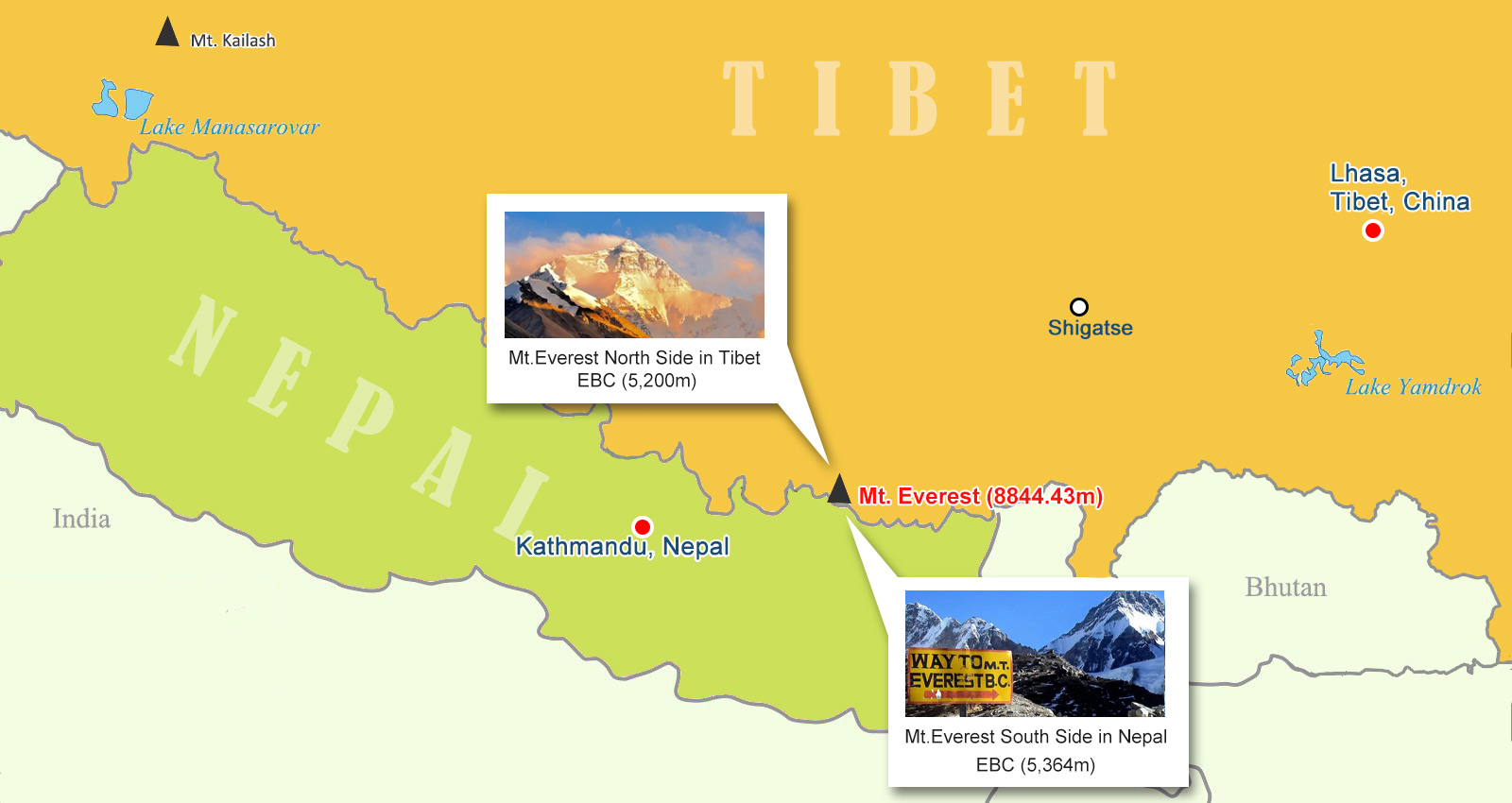
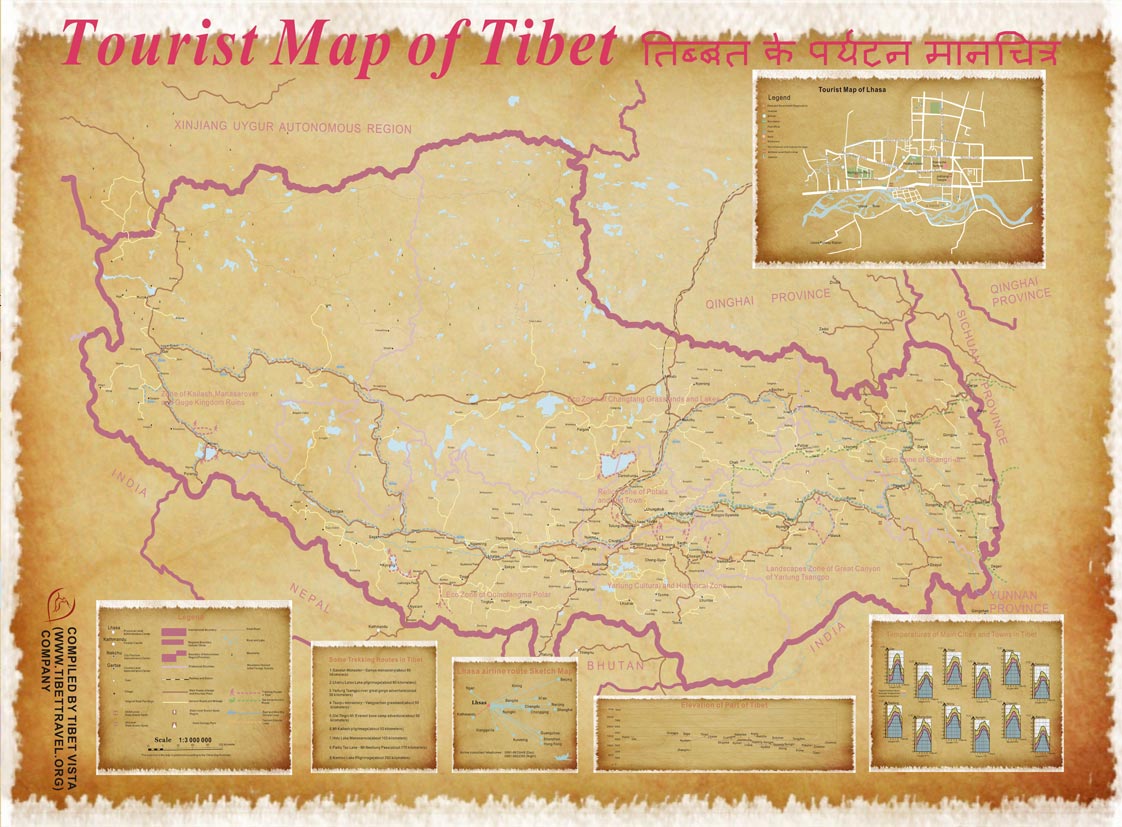

Mount Everest is located in the Himalayas on the border between the Tibet Autonomous Region in China and Nepal. The north face of Mount Everest lies on the Tibetan side, while the south face lies on the Nepalese side.
There are also separate Everest Base Camps on the two sides of Mount Everest. Tibet Everest Base Camp, often called the North Base Camp, is located on the northern side of Mount Everest in Tingri County of Shigatse, Tibet. Nepal Everest Base Camp, also known as the South Base Camp, is located on the southern side of Mount Everest inside Sagarmatha National Park in Nepal.
Because of this unique location, Mount Everest can be visited from two completely different directions, each offering different Everest Base Camp routes, travel styles, and Himalayan experiences. The Tibet side provides direct overland access to Mount Everest, while the Nepal side is mainly reached through multi-day Himalayan trekking routes.
Although both sides lead to Mount Everest, the travel experiences are very different. The Tibet side is known for panoramic Everest views, comfortable overland journeys, and easier access. In contrast, the Nepal side is famous for classic Himalayan trekking, Sherpa culture, and immersive mountain scenery.
| Aspect | Tibet Everest Base Camp | Nepal Everest Base Camp |
| Location | North side of Mt. Everest | South side of Mt. Everest |
| Altitude | About 5,200 meters | About 5,364 meters |
| Transportation | Overland drive or trekking | Trekking only |
| Accommodation | Guesthouses and tent hotels | Teahouses and trekking lodges |
| Best for | Comfortable Everest travel | Classic Himalayan trekking |
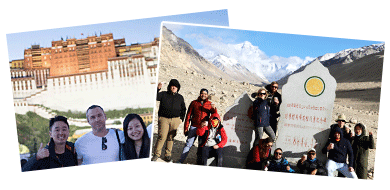
Our guest enjoys clear views of Mount Everest during the journey to Everest Base Camp.Mount Everest North Route Map: Tibet Overland Route to Everest Base Camp from Lhasa
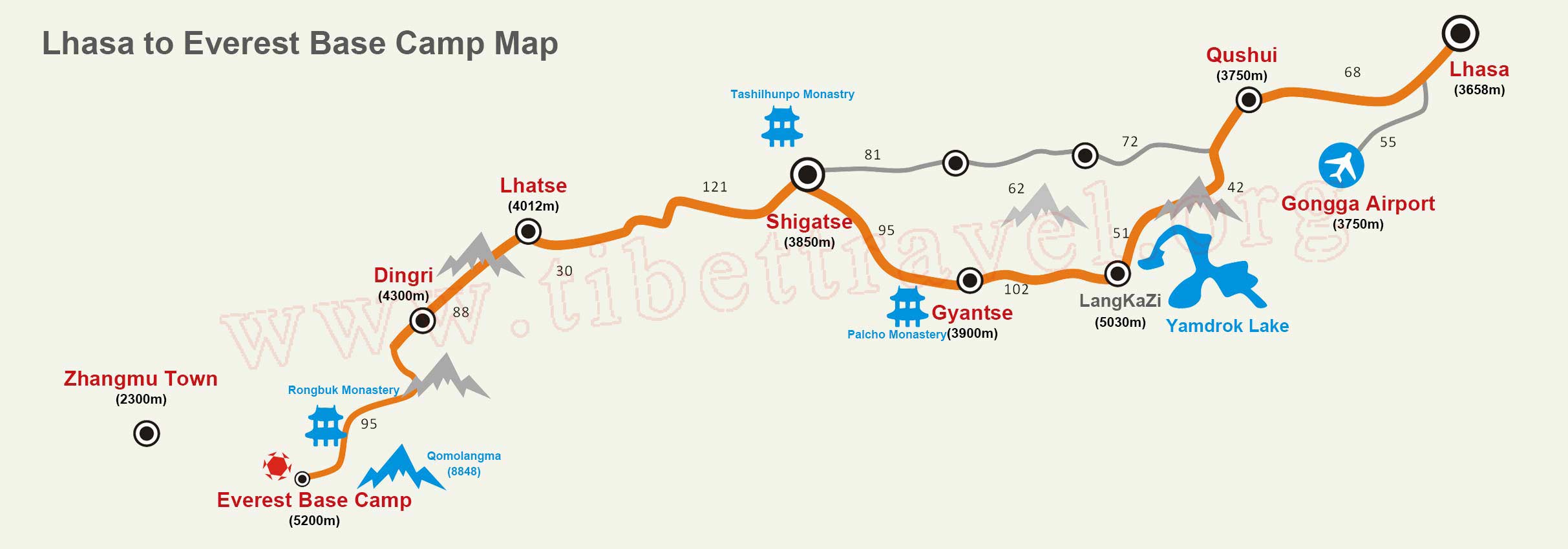
Route: Lhasa → Gyantse → Shigatse → Tingri → Tibet Everest Base Camp
8 Days Lhasa to Everest Base Camp Tour MapAlthough there are several ways to reach Everest Base Camp, the Tibet overland route from Lhasa is the most comfortable and popular Everest Base Camp tour route for first-time travelers. This classic Everest Base Camp tour route combines breathtaking Himalayan scenery, rich Tibetan culture, and gradual altitude acclimatization, making it ideal for visitors of all ages.
The route mainly follows the well-maintained G318 National Highway. The overland journey covers approximately 600 to 700 kilometers and usually takes around 2 days by car. The altitude gradually increases from Lhasa at 3,650 meters to the Tibet Everest Base Camp at around 5,200 meters, allowing enough time to acclimatize comfortably.
The entire Tibet Everest Base Camp tour normally takes about 7 to 8 days, combining stunning Himalayan scenery, Tibetan cultural experiences, and some of the most spectacular landscapes in Tibet.
Starting from Lhasa, you will first visit Yamdrok Lake, one of the three holy lakes in Tibet, where you can enjoy the turquoise lake scenery, visit a local Tibetan family, and have lunch with locals.
Then, you will pass by the Karola Glacier and the old town of Gyantse and reach Shigatse, the second-largest city in Tibet. Here, you can visit Tashilhunpo Monastery, the traditional seat of the Panchen Lama. Most travelers spend one night in Shigatse before continuing to Everest Base Camp the next day.
From Shigatse, you’ll take another day’s drive to Everest Base Camp via Tingri. Because of the well-maintained roads, this journey is suitable for travelers of all ages, including families with children and senior travelers, as you can get to the base camp directly by car without any trekking.
There are also alternative ways to reach Everest Base Camp from Tibet. For example, you can first take a train from Lhasa to Shigatse and then continue by car to Everest Base Camp. Some travelers may also choose to fly to Shigatse before joining the overland journey. However, flying is generally less recommended because the faster altitude gain may increase the risk of altitude sickness.
Overall, the Tibet Everest Base Camp tour route is suitable for first-time visitors. If you prefer visiting the Tibet Everest Base Camp in a more comfortable way while enjoying the dramatic Himalayan landscapes, our popular 8-Day Lhasa to Everest Base Camp Small Group Tour is highly recommended.
Join our most popular Everest Base Camp tour and enjoy a once-in-a-lifetime Himalayan adventure.
Tibet Everest Base Camp Trek Route Map from Old Tingri
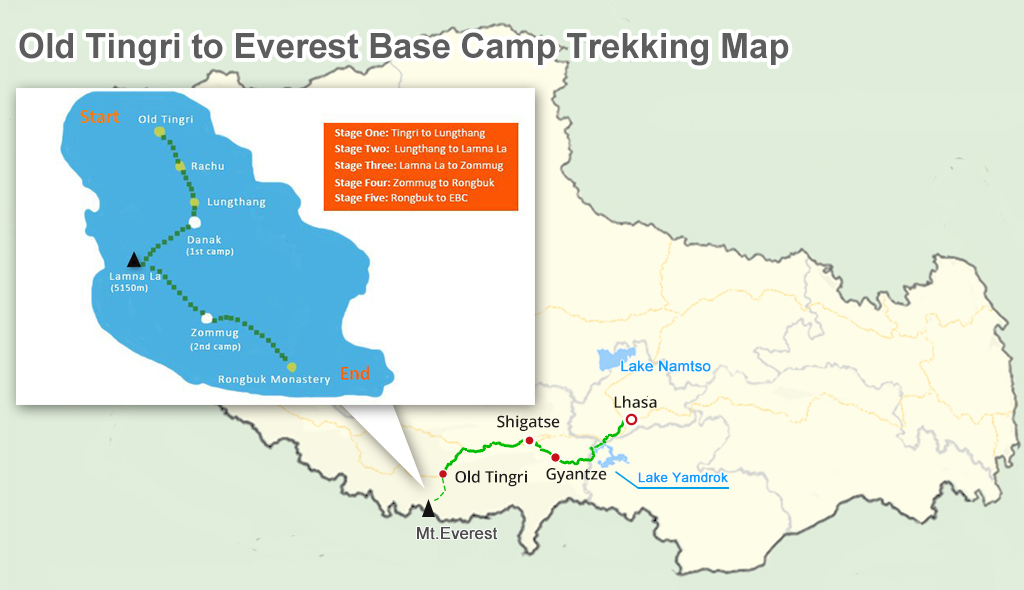
Route: Old Tingri → Lungthang → Lamna La → Zommug → Rongbuk Monastery → Tibet Everest Base Camp
Trekking from Old Tingri to Everest Base Camp is one of Tibet’s most popular trekking routes for adventure travelers. You’ll first take an overland journey from Lhasa to Old Tingri in Shigatse and then start trekking from there. The total trekking distance is about 70 kilometers and usually takes around 4 days to complete.
Here’s the typical trekking itinerary from Old Tingri to the Tibet Everest Base Camp:
| Day | Route | Trek Distance | Trek Time |
| 1 | Tingri - Lungthang | 12 km | 5 hrs |
| 2 | Lungthang - Lamna La | 21 km | 8 hrs |
| 3 | Lamna La - Zommug | 22 km | 8 hrs |
| 4 | Zommug - Everest Base Camp | 15 km | 6 hrs |
Day 1: Trek from Old Tingri to Lungthang through the Ra-Chu Valley with a visit to Choelun Monastery along the route.
Day 2: Trek from Lungthang to Lamna La Pass, which is the most challenging section of the route, with panoramic views of Mount Everest and surrounding valleys.
Day 3: Continue trekking to Zommug through remote Tibetan grasslands with views of grazing yaks and traditional Tibetan villages.
Day 4: Trek to Rongbuk Monastery and the Tibet Everest Base Camp, where you can enjoy panoramic views of Mount Everest and the world’s highest monastery.
Accommodation during the trek is relatively basic, with simple guesthouses and occasional camping arrangements in remote areas.
This Everest Base Camp trekking route is ideal for travelers who prefer remote Himalayan trails and closer Everest views. If you are looking for a trekking route on the northern side of Mount Everest, our 10-Day Everest Trekking Small Group Tour is highly recommended.
10 Days Old Tingri to Everest Base Camp Trek Tour MapJoin our classic Tingri to Everest Base Camp trekking tour and enjoy panoramic views of Mount Everest along the journey.
Mount Everest South Route Map: Nepal Trek Route to Everest Base Camp from Lukla
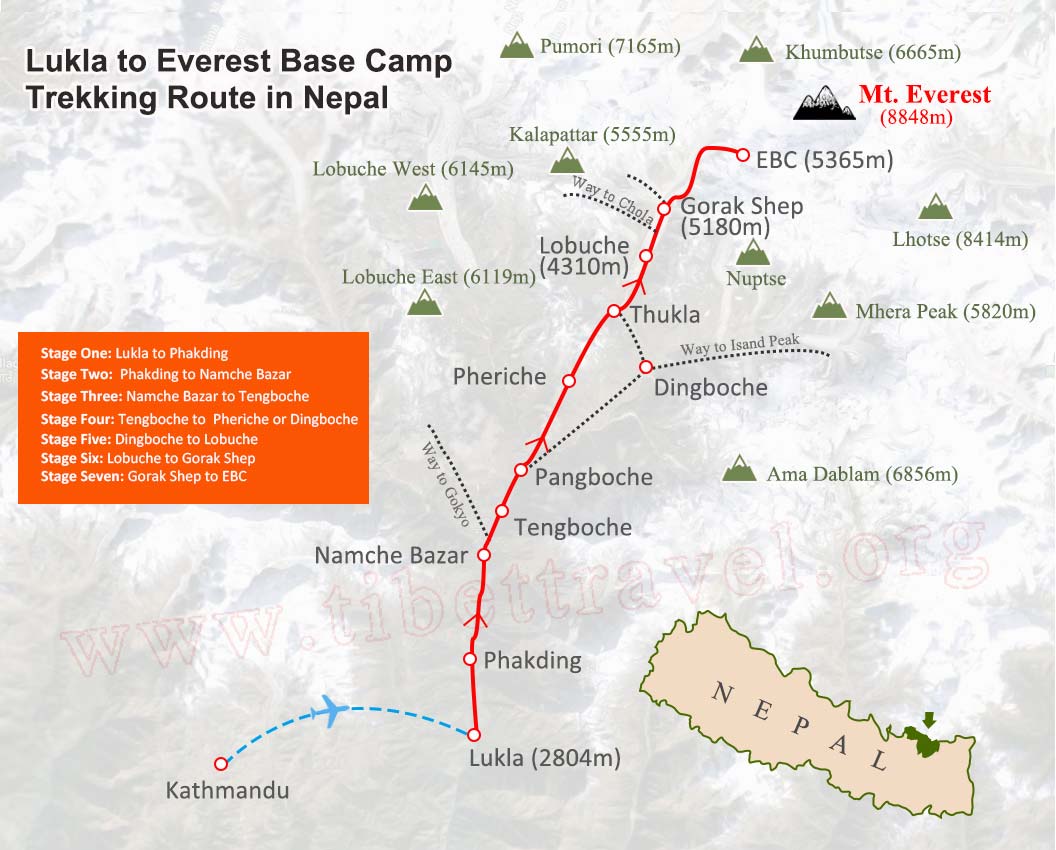
Route: Lukla → Phakding → Namche Bazaar → Tengboche → Lobuche → Gorakshep → Nepal Everest Base Camp
The Nepal Everest Base Camp route can only be completed through trekking because there is no direct road access on the Nepal side. Although the Nepal Everest Base Camp trekking route is more physically demanding than the Tibet overland route, it offers breathtaking Himalayan scenery. The whole trekking distance is about 130 kilometers, taking about 12 to 17 days to complete (including the return journey), depending on the trail conditions and trekking pace.
Here’s the typical trekking itinerary from Lukla to Nepal Everest Base Camp (not including the return journey):
| Day | Route | Trek Distance | Trek Time |
| 1 | Lukla - Phakding | 8 km | 5 hrs |
| 2 | Phakding - Namche Bazaar | 11 km | 6 hrs |
| 3 | Namche Bazaar acclimatization | / | / |
| 4 | Namche Bazaar - Tengboche | 10 km | 5 hrs |
| 5 | Tengboche - Dingboche | 11 km | 6 hrs |
| 6 | Dingboche - Lobuche | 9 km | 6 hrs |
| 7 | Lobuche acclimatization | / | / |
| 8 | Lobuche - Gorakshep - Kala Pattar - Gorakshep | 10 km | 6 hrs |
| 9 | Gorakshep - Everest Base Camp - Gorakshep | 7 km | 7 hrs |
Day 1: Fly from Kathmandu to Lukla and begin trekking to Phakding through the scenic Dudh Koshi Valley.
Day 2: Trek along the Dudh Koshi River to Namche Bazaar with panoramic views of Mount Everest, Lhotse, and surrounding Himalayan peaks.
Day 3: Spend a full acclimatization day in Namche Bazaar to adjust to the higher altitude.
Day 4: Trek from Namche Bazaar to Tengboche and visit the famous Tengboche Monastery surrounded by Himalayan peaks.
Day 5: Continue trekking to Dingboche with spectacular views of Mount Ama Dablam and the surrounding mountains.
Day 6: Trek to Lobuche while passing memorial sites dedicated to climbers who lost their lives on Mount Everest.
Day 7: Take another acclimatization day at Lobuche before continuing toward Everest Base Camp.
Day 8: Trek to Gorakshep, the last settlement before Everest Base Camp, and hike to Kala Patthar for one of the best panoramic views of Mount Everest.
Day 9: Trek from Gorakshep to Nepal Everest Base Camp and enjoy close views of the famous Khumbu Icefall.
The return journey follows a similar route, but usually takes less time because most of the route is downhill. The Nepal Everest Base Camp trekking route is ideal for travelers who prefer classic Himalayan trekking, Sherpa culture, and close-up mountain scenery. If you enjoy long-distance mountain trekking and close-up views of the Himalayas, our 17-Day Nepal Everest Base Camp Trek Tour is recommended.
Trek from Lukla to Nepal Everest Base Camp while discovering Sherpa culture and the majestic Mount Everest up close.
Mount Everest Tourist Route Maps Comparison: Which One Suits You Best?
Choosing the right Everest Base Camp tour route depends on your travel style, fitness level, trekking preference, and overall travel expectations. Here’s a comparison table of the three popular Mount Everest tourist routes to help you choose:
| Aspect | Tibet Overland Route to EBC | Tibet Trek Route to EBC | Nepal Trek Route to EBC |
| Accessibility | Overland drive | Moderate trekm | Moderate trek |
| Road access | Direct road access | Partial road access | No direct road access |
| Trekking required | Minimal | Multi-day trekking | Multi-day trekking |
| Travel style | Comfortable overland journey | Trekking journey | Trekking journey |
| Altitude range | 3,650 - 5,200 m | 4,300 - 5,200 m | 2,860 - 5,364 m |
| Difficulty | Easy | Moderate to challenging | Moderate to challenging |
| Travel duration | 7 - 8 days | 10 - 12 days | 12 - 17 days |
| Accommodation | Hotels; guesthouses; tent hotels | Basic guesthouses; camping | Trekking lodge; camping |
| Best season | April - June; September - November | April - June; September - October | September - November |
| Everest viewing experience | Panoramic north face views of Mount Everest | Remote Everest views along the trekking route | Close-up views of Everest and surrounding Himalayan peaks |
| Best for | First-time visitors; photographers; travelers of all ages | Experienced trekkers; adventure travelers | Experienced trekkers; classic Himalayan adventure lovers |
Overall, the Tibet overland route is best for first-time travelers and visitors looking for comfort and easy Everest access, while the Tibet and Nepal trekking routes are better for those seeking deeper Himalayan trekking experiences.
Our guests enjoy a comfortable journey to Everest Base Camp through the Tibet overland route.Travel from Lhasa through the Everest Base Camp to Mount Kailash, enjoying remote Tibetan landscapes along the way.
Optional Mount Everest Summit Climbing Routes
Besides Everest Base Camp tour routes, some experienced climbers also choose summit expedition routes from Tibet or Nepal.
Climbing Mount Everest from Tibet (North Face Route)
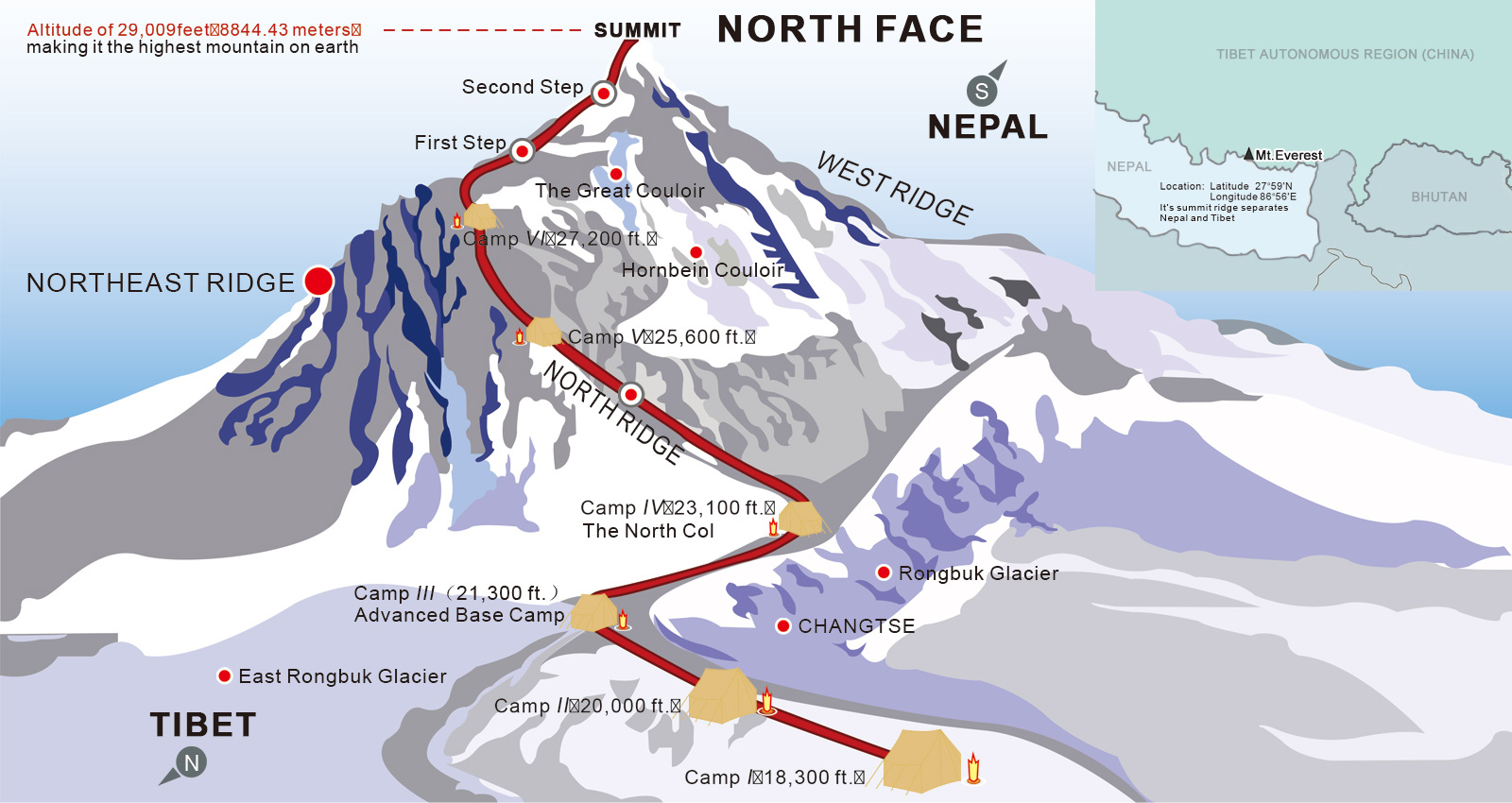
Route: Everest Base Camp → Advanced Base Camp → North Col → Camp II → Camp III → Summit
If you choose the North Face Route from Tibet, you will first travel overland from Lhasa to Everest Base Camp before beginning your Everest climbing expedition.
The early stage of the climb follows the East Rongbuk Glacier across rocky trails and glacier terrain toward Advanced Base Camp at 6,400 meters. Then you may spend several days acclimatizing by trekking to higher elevations and returning to camp. Once fully acclimatized, you can gradually move higher to the North Col at 7,000 meters, then continue to Camp II at 7,800 meters and Camp III at 8,300 meters.
Summit day normally begins around midnight. You need to cross the First Step, Second Step, and Third Step before finally reaching the summit of Mount Everest at 8,848.86 meters.
Climbing Mount Everest from Nepal (South Col Route)
Route: Everest Base Camp → Khumbu Icefall → Camp I → Camp II → Camp III → Camp IV → South Col → Summit
If you choose the South Col Route from Nepal, you will first trek from Lukla to the Nepal Everest Base Camp before starting your Everest climbing expedition.
During the first several days at Everest Base Camp, you’ll focus on acclimatization and basic climbing training. You can hike to nearby areas and practice using fixed ropes, ladders, and glacier equipment.
The first major challenge is crossing the Khumbu Icefall to reach Camp I at 6,000 meters, then continuing to Camp II in the Western Cwm, where you may spend several days acclimatizing to the high altitude. Next, you can ascend the steep Lhotse Face to Camp III at 7,200 meters before moving to Camp IV at the South Col at nearly 8,000 meters.
Summit day begins at the South Col. You’ll ascend past the Balcony and South Summit before reaching the summit of Mount Everest.
Note: Climbing Mount Everest is an extreme high-altitude expedition that requires advanced mountaineering skills, extensive preparation, and professional expedition support.
Climbing Mount Everest is dangerous.Best Time to Visit Everest Base Camp by Route
The best time to visit Mount Everest depends largely on which Everest Base Camp tour route you choose. Weather conditions, mountain visibility, temperature, and trekking conditions can vary greatly between Tibet and Nepal throughout the year.
For Tibet overland tours to Everest Base Camp, the best travel seasons are from April to June and from September to November. During these months, road conditions are better for overland travel, allowing you to enjoy clear panoramic views of Mount Everest.
The best time to trek from Tingri to Tibet Everest Base Camp is from April to June and September to October. These periods offer better trekking conditions across the high-altitude grasslands, mountain passes, and remote valleys between Old Tingri and Everest Base Camp.
For the Nepal Everest Base Camp trek, the best trekking season is from September to November. After the summer monsoon, the skies become much clearer, offering spectacular Himalayan views and excellent trekking conditions through Sherpa villages and mountain valleys
In addition, for Everest summit climbing, the best climbing seasons are from April to May and from September to November. These months are known for more favorable summit windows, lower wind speeds, and safer climbing conditions on Mount Everest.
| Route | Best Time | Why Visit During This Season |
| Tibet Overland Route to EBC | April - June; September - November | Clear Everest views and comfortable road travel |
| Tibet EBC Trek Route | April - June; September - October | Better trekking conditions across remote mountain terrain |
| Nepal EBC Trek Route | September - November | Clear Himalayan views after the monsoon season |
| Mount Everest Summit Route | April - May; September - November | Safer summit windows with lower wind speeds |
Our guest visits Everest Base Camp in May and enjoys clear views of Mount Everest.Enjoy a comfortable overland tour from Lhasa to Everest Base Camp and Namtso Lake across Tibet’s stunning landscapes.
Practical Travel Tips for Everest Base Camp Routes
Required Permits
If you visit the Tibet Everest Base Camp from the Tibet side, you need the following permits:
- Tibet Travel Permit
- Alien’s Travel Permit
- Trekking Permit for the Everest Base Camp to Advanced Base Camp trek
In addition, foreign travelers can’t travel independently in Tibet and must join an organized Tibet tour arranged through a registered travel agency. The agency will help you apply for these permits.
If you visit Everest Base Camp from the Nepal side, you need the following permits:
- Sagarmatha National Park Entry Permit
- Khumbu Pasang Lhamu Rural Municipality Permit
For travelers who want to climb Mount Everest from either Tibet or Nepal, you need to obtain a permit to climb Mount Everest. You need to choose an authorized Everest expedition company in China or Nepal, and the company will help submit your documents to apply for the Everest Climbing Permit.
Altitude Sickness
Altitude sickness is one of the most important things to consider when visiting Mount Everest. To reduce the risk of altitude sickness, it is important to:
- Spend at least 1 to 2 nights in lower-altitude areas before visiting Mount Everest.
- Get enough rest during acclimatization and avoid strenuous activities in the first few days.
- Stay hydrated, eat light meals, and avoid alcohol.
- Move slowly and steadily, and watch for symptoms such as headache, dizziness, or shortness of breath. If you feel any discomfort, inform your guide immediately.
Accommodation
Accommodation conditions vary between the Tibet and Nepal Everest routes. Along the Tibet overland route, you can stay in hotels and guesthouses in major cities such as Lhasa and Shigatse. Accommodation near Tibet Everest Base Camp is more basic, with tent hotels and Rongbuk Hotel being the most popular choices.
On the Nepal Everest Base Camp trek route, accommodation mainly consists of lodges and mountain teahouses operated by local Sherpa families. Facilities are generally simple but comfortable enough for trekkers.
You can see Mount Everest directly from the windows of the Rongbuk Hotel.Summary and FAQs about Everest Base Camp Tourist Routes
Quick summary
Mount Everest offers several Everest Base Camp tour routes from both Tibet and Nepal, but the travel experiences vary greatly depending on the route you choose. The Tibet side offers both comfortable overland journeys and remote trekking routes to Everest Base Camp. The Nepal side is known for its classic Himalayan trekking experience through Sherpa villages, suspension bridges, and mountain trails.
Q1: What is the difference between the Everest Base Camp in Tibet and the Everest Base Camp in Nepal?
The main difference between the Tibet Everest Base Camp and the Nepal Everest Base Camp is the travel style and accessibility. Tibet Everest Base Camp can be reached directly by road, offering panoramic views of the north face of Mount Everest with less trekking required. Nepal Everest Base Camp is reached through a multi-day Himalayan trek.
Q2: What is the easiest way for first-time travelers to reach Everest Base Camp?
The easiest way for first-time travelers to reach Everest Base Camp is the Tibet overland route from Lhasa. You can reach the Tibet Everest Base Camp directly by road without a long trek while enjoying comfortable travel conditions and stunning Himalayan scenery along the way.
Q3: Can foreigners visit Everest Base Camp in Tibet?
Yes. Foreign travelers can visit Everest Base Camp in Tibet by joining an organized tour. You can choose from a variety of Tibet Everest Base Camp tours, including overland tours, trekking tours, and cycling tours from Lhasa to Everest Base Camp.
Q4: How long does the Tibet Everest Base Camp tour take?
Most Tibet Everest Base Camp overland tours take about 7 to 8 days from Lhasa. There are also longer itineraries that include destinations such as Namtso Lake and Mount Kailash.
Q5: Is the Tibet Everest Base Camp trekking route difficult?
The Tibet Everest Base Camp trek from Old Tingri is considered moderately challenging because of the high altitude and long trekking distances. Although the trail itself is not technically difficult, it requires good physical fitness and some high-altitude trekking experience.
Q6: Is the Nepal Everest Base Camp trekking route difficult?
The Nepal Everest Base Camp trek is also moderately challenging. Trekkers usually walk for many days at high altitude while gradually climbing through the Himalayas, which requires good fitness and some high altitude trekking experience.
Q7: Which Everest route requires the least trekking?
The Tibet overland route from Lhasa requires the least trekking because you can reach Tibet Everest Base Camp directly by vehicle. It is the best option for first-time travelers, seniors, families, photographers, and travelers who prefer a more comfortable Everest experience.
Q8: Which Everest route offers the best views of Mount Everest?
The Tibet Everest Base Camp overland route is widely considered the best route for panoramic views of Mount Everest. Along the journey, you can find some of the best Everest viewpoints in Tibet to enjoy a full view of the north face of Mount Everest directly from Rongbuk Monastery and the Tibet Everest Base Camp without a long trek.
Q9: Which Everest route is better for avoiding altitude sickness?
The Tibet overland route is generally better for acclimatization because you gradually gain altitude while driving from Lhasa to Everest Base Camp.
Travel overland from Lhasa to Kathmandu and experience an unforgettable journey through Tibet Everest Base Camp.
Conclusion
In summary, Mount Everest offers several unforgettable Everest Base Camp tour routes from both Tibet and Nepal, each designed for different travel styles and trekking experiences.
If you prefer easy access, panoramic Everest views, and less trekking, the Tibet Everest Base Camp overland tour is usually the best choice. If you are looking for remote trekking experiences and classic Himalayan trails, both the Tibet Everest Base Camp trek and the Nepal Everest Base Camp trek offer incredible journeys through some of the world’s most spectacular mountain landscapes.
No matter which Everest route you choose, visiting Mount Everest is a once-in-a-lifetime experience filled with breathtaking scenery, unique Tibetan and Himalayan culture, and unforgettable travel memories. Don’t hesitate to contact us to customize your ideal Everest Base Camp tour in Tibet or Nepal.
Search


700.jpg)