
.jpg "Tibetan Local Travel Agency")




Cycling in Tibet
Have you ever imagined cycling at the top of the world? Or is it a crazy idea that would have been impossible to even think of before? Yes, it is very hard to cycle in Tibet, but it is indeed possible to enjoy a cycling tour in Tibet if you dare to challenge yourself both physically and psychologically. You will be rewarded with stunning scenery and the big feast of Tibetan culture when cycling in Tibet. However, good preparation and professional organization are necessary. Don't hesitate to ask for help from Tibet travel org to arrange your Tibet biking tour as we know this land very well.
Preparation
Tibet Permits
As you probably know that Tibet entry permit is a must for foreigners to travel to Tibet. You will be asked to show it when boarding a train or flight to Tibet. Besides, Aliens' travel permit is required if you travel to prohibited areas of Tibet and the military permit is needed for visiting military areas of Tibet. Sometimes, it is easy to get Tibet permits, while you might also have all kinds of trouble in getting it sometimes. Anyway, just feel free to ask for help from Tibet travel org if you have such troubles. See details about Tibet permits.
Bike
Mountain bikes are good partners for you to cycle in Tibet. In recent years, more and more foreign travelers to Tibet choose to bike from Lhasa to Kathmandu with the loosening of the policy on foreign tourists to Tibet. We also have designed other cycling routes to meet cyclists' different tastes. With the development of Tibet's tourism, nowadays it is easy to buy or rent a mountain bike in Lhasa. After finishing the cycling trip in Tibet, you can sell the bike to locals at a considerable price. Of course, you can also carry your own bike to Tibet if you do not have confidence in the mountain bikes sold or rented in Lhasa. No matter how you obtain the bike, make sure it is strong and reliable enough mechanically, and you are able to maintain the bike in any case. So you need to take the necessary tools and spare parts, like inner tubes, outer tubes, brake wires, transmission wires, transmission, chains, freewheels, spoke and service tools. If there are several members in your group, it is advisable to use the same kind of bikes so that you can share the parts.
Necessities
No matter you have a support car or not, a good water-proof tent, a warm sleeping bag, a first-aid kit and adequate food and water are what should be packed at least. It is very hard to buy these things when you are traveling remote areas of Tibet. You might be able to obtain tsamba, buttered tea, yak meat, Tibetan tea and other simple Tibetan food in some Tibetan villages on the way. There might be small shops selling instant noodles or fried noodles in some parking lots. However, you cannot find a shop in most villages of Tibet. If you are really lack of food, you can buy some vegetable, noodles or meat from local Tibetans who are willing to sell them.
A map is must for you to cycling in Tibet if you do not hire a tour guide. But basically, foreigners are required to travel in Tibet with the companion of a local tour guide. Anyhow, taking a map will be helpful. The tour guide can help you make a good communication with local Tibetans, especially when you need to ask the way, such where you can find a shop on the way, how long does it take to next village or camp site. Even if you have a map, these questions will come into your mind frequently when cycling in Tibet.
Sometimes, you have to arrive at your scheduled daily destination according to your food supply. But if you are already very tired and impossible to cover another 30km to your campsite, you need to adjust your schedule and find extra supply. At this time, asking help from local people is a must.
Weather and clothes
As we know, the temperature in Tibet varies greatly between day and night. Even in summer, the temperature might drop from 20°C at daytime to -10°C at night. In July and August, it may rain continued for several days. You even can confront on a snowy day. Therefore, warm clothes and shoes are necessary for traveling in Tibet. In addition, it is best to take along a waterproof coat and a pair of water-proof shoes.
Besides, the wind in Tibet is usually quite strong at mountain areas of Tibet, so wind-proof clothes will make you more comfortable during cycling in Tibet.
In a word, don't forget warm clothes at least though cycling pants and short-sleeved T-shirts are enough during cycling in summer unless you are willing to become a frozen man at mid-night when sleeping. Spare sports pants, long-sleeved sports shirts, wind-proof coat, and gloves are also highly recommended so that you can cope with most situations on your journey if weather is good. But the weather in Tibet is usually unpredictable. It might be sunny and hot on one side of a mountain, but it rains heavily on the other side of the mountain. Thus, do prepare to deal with all kinds of weather.
Physical training
No matter you plan to travel in Tibet by car or bike, good physical condition is important. Of course, cycling in Tibet requires a higher physical condition. Before starting your tour to Tibet, make a two or three months' plan to enhance your cardiovascular system. Climbing a mountain is a good way to strengthen it. The higher altitude, the better effect. Besides, do exercises to boost your whole body capacity twice or three times a week. Good health will help you acclimate the altitude of Tibet quickly and cope with high physical consumption during biking in Tibet.
The standard requirements to do cycling include maintaining standard weight, keeping healthy, having enough rest and proper diet, proper multivitamin and mineral supplement and drinking enough water.
Do remember that do not start cycling before fully acclimating the altitude of Tibet. Normally, two or three days in Lhasa are enough for acclimation, but some cyclists might need one week to adjust to the suddenly-changed altitude. Just keep relaxing and avoid strenuous exercise after your arrival at Lhasa, which is helpful in quick acclimation.
You can do some short cycling in and around Lhasa city after two days' acclimation. It is interesting to cycle to visit the tourist sites in Lhasa. For instance, you can bike from Lhasa to Ganden Monastery 50km from Lhasa, or to Sera Monastery to watch its Buddhist Scripture Debating, or to Drepung Monastery located at the suburb of Lhasa.
What to Pack
Equipments
1. A mountain bike and spare parts and maintenance tools, including two inner tubes, one outer tube, a chain puncher, an inflator, a socket head wrench, two brake cables, four brake rubbers, a chain corrector, pinchers, glue, etc.
2. A knapsack (bicycle saddlebag).
3. Compass, elevation watch, torch, ten spare batteries.
4. A long string of firecrackers. Cut the firecrackers into two to four shorter strings and put one at hand so that you can use it to scare away wild animals attacking you. In addition, you need a box of match, instead of lighter. A lighter might not work at a high altitude due to lack of Oxygen. In fact, firecrackers are the best weapon to cope with attacking wild animals. A gun or knife in hand might be helpless, at night in particular.
5. 500ml of alcohol used for sterilization in case of being injured.
6. 500ml of gasoline. In case you are attacked by wild animals at night, you can light the gasoline to scare them. (Light the firecrackers at first.)
7. A long stick used for self-defense. It is more useful than a knife.
8. High altitude tent, warm sleeping bag, self-inflating mattress, moisture-proof pad.
9. Padded jackets, down clothes, water-proof coat, pants and shoes, hat, sunglasses, lipstick.
10. Alcohol stove or gas stove and bottled alcohol or gas for cooking food or boiling water. If you drink cold water and eat cold food all the way, I am afraid it will influence your health.
11. Two ropes, a pair of scissors and a knife.
Medicine
1. Anti-Trauma: Safflower Oil, Band-aid, Mercurochrome, Gauze, Adhesive Plaster, Bandage, Alcohol.
2. Anti-mouth and throat disease: Caoshanhu Buccal Tablets, Mirabilitum Praeparatum Buccal Tablets.
3. Anti-heat and inflammation: Radix Isatidis Infusion.
4. Anti-pneumonia: Toupaoanbian Capsule, Ofloxacin.
5. Anti-anoxia: Glucose.
6. Anti-inflammatory: Spiramycin.
7. Anti-gastrointestinal disease: Domperidone, Norfloxacin, Ageratum-liquid.
8. Anti-cold: Vitamin C Yinqiao tablets used for handle pneumonia. In Tibet, a cold easily translates into emphysema and a cough into pulmonary disease.
Food
In remote areas of Tibet, it is difficult to find a store or restaurant. So you need to prepare some food for your cycling trip in Tibet. Instant food is the best, like instant noodles, ham sausage, steamed bread, pickles, chocolate, drinks, alcohol for warming your stomach after eating cold food and drinking water.
Clothes
The temperatures change greatly in different areas of Tibet and between day and night. In Lhasa, the temperature in July arrives at 30 degrees centigrade at daytime but falls to 10 degrees centigrade at night. While the temperature at mountain areas is much lower than that in Lhasa. Sometimes it will snow or sleet at night, so you'd better take some down garments (those with hats will better), woolen sweaters, warm gloves, warm and wind-proof shoes and socks. Wear several layers of clothing that can be easily added or removed. Even in summer, a down coat is necessary for those who are traveling beyond Lhasa and Shigatse into more remote areas such as Everest Base Camp.
Other things
Skin care products such as sunblock and lipstick, sunglasses, all necessary toilet items including small packages of tissues and either a battery operated shaver or razor, spare batteries and so on.
More advice at http://www.tibettravel.org/tibet-travel-advice/what-to-pack.html.
How to get to Tibet
Currently, tourists can by several means and routes from Mainland China or Nepal. From China mainland, most travelers fly to Lhasa from Chengdu, Beijing and Shanghai. It is also possible to take a flight to Lhasa from Xining, Shangrila, Xian, Chongqing, Guangzhou and Kathmandu, capital of Nepal. See all flights to Tibet.
However, the most popular way of traveling to Tibet is by train due to the world's highest railway – Qinghai-Tibet Railway. At present, there are trains to Lhasa from Beijing, Chengdu, Shanghai, Guangzhou, Chongqing, and Xining. See all trains to Tibet.
For foreign travelers, by air, and by train are their common ways to Tibet. For Chinese, self-driving and biking are also popular ways of getting to Tibet.
How to get a bike in Tibet
1. Purchase
Nowadays it is possible to buy a mountain bike in Lhasa for about Y500. The mountain bikes sold in Lhasa are mostly made in China, like Chinese Flying Pigeons. There are several bike shops in Lhasa. After finishing your cycling tour in Tibet, you can sell your bike to local people.
2. Rental
Also, you can rental a bike there. The only place in Tibet where you can easily rent bicycles is Lhasa. The rate is Y3 to Y5 per hour or Y20 to Y30 per day for normal bikes and Y50 to Y60 per day for mountain bikes. The bikes are usually Chinese Flying Pigeons. Test the brakes and tires before taking the bike out onto the streets. Tibet Vista can arrange the technical bicycle for our clients.
3. Pack your own bike to Tibet
For long distance cyclists, they prefer using their own bikes. Long distance cyclists are commonly appearing on the roads of Tibet, but most of them are Chinese youths. Most cycles to Lhasa along Sichuan-Tibet Highway or Qinghai-Tibet Highway and then send their bikes back home after cycling in Tibet. Some foreigners also pack their bikes to Lhasa and then cycle along the Friendship Highway to Katmandu. Few also buy mountain bikes in China and bring them up to Lhasa.
How to send your bicycle to Tibet? You can send your bike to Lhasa by air or by train. Do pay attention to the package of your bike. Different airlines have different specific requirements on the package. Some airlines do not offer service of transporting unpacked bicycles. If you send your bike to Lhasa by train, your package must meet the following requirement: the width, height, length of one piece of luggage is limited within 160cm; the length of luggage in shape of the pole is limited within 200cm.
Tips for cycling in Tibet
1. Banks in Tibet: There are few banks in Tibet. Though there are several banks in Lhasa, it is difficult to find banks outside of Lhasa city. Thus, take some cash with you.
2. Season to cycle in Tibet: It is best to avoid July and August which are the rainy season of Tibet. The roads in Tibet are easily interrupted by rainfall and landslide during these two months. The best time to bike in Tibet is May, September and October.
3. Have good rest and maintain energy as you can. Since you are doing sport in a place with average altitude over 3500m, do not run a risk to cycle too fast on the Tibet highland. Have a rest when you feel tired.
4. Prevent your head from cold wind by headscarf or hat; otherwise it is easy to catch a cold during biking.
5. If the weather is bad, take some medicine to prevent cold in advance.
6. Don't choose campsite at the lower mountain stream for it is very dangerous when a sudden food happens at night.
7. Protect the environment; don't dump trash everywhere.
Biking routes in Tibet
1. Lhasa to Kathmandu – Cycling Friendship Highway
Cycling from Lhasa to Kathmandu is the most popular biking route in Tibet. It usually takes 13 to 16 days to cover this route of 946km. You need to climb over 6 high passes all the way before you completely traversing the Himalayas. During this Tibet tour, you can see the world's highest peak, Mount Everest, the most attractive two cities in Asia, Lhasa and Kathmandu.
In fact, it is better to spend at least 3 weeks to accomplish the cycling; one month is the best. You need to spend around a week in Lhasa to acclimate the highland and prepare for the cycling tour from Lhasa to Kathmandu. Then it takes 5 days to finish 251km from Lhasa to Gyantse, an interesting traditional Tibetan town where you can stay for one day to have a good rest. En route you will climb over the Kambala Pass at 4,794m and see beautiful sceneries of Yamdrok Lake, Karola Glaciers, snow-capped mountains and historical and cultural sites like Gyantse Dzong, Palkor Monastery with Gyantse Kumbum.
Cycling from Gyantse to Shigatse, the second largest city of Tibet, needs a full day. You can make a detour to Shalu Monastery on the way. Then, spend one day in Shigatse to explore the famous Tashilunpo monastery, Summer Palace of Panchen Lamas and local market which is the last big market before your arrival at Kathmandu.
From Shigatse to Shegar, it takes 3 to 4 days and you have to climb over the Lagpa La at 5,220m, the highest pass on this route. Take another day from Shegar to Tingri where you can make a long detour to Rongbuk Monastery, the highest temple in the world, and Everest, the highest peak in the world.
After Tingri, another high pass, Thang La at 5,200m is waiting for you. Once overcoming this pass, you will cycle down to Zhangmu at Chinese-Nepal border. From Tingri to Zhangmu, it takes two days' biking.
Kathmandu is around 116km away from the border. The beautiful scenery along the steep valley will slow down your steps. One or two days, even more, will take you to the last destination of this cycling trip.
2. Central Tibet Biking Tour
If you just want to try a short cycling in Tibet, it is perfect to enjoy a short biking tour in central Tibet to explore the unique culture and history of Tibet as well as viewing the amazing natural beauty of the Tibetan highland. A good acclimation of the high altitude in Lhasa is also a must. Start your cycling to visit the sites in Lhasa city, and then to Ganden Monastery, the Yarlung Valley, the Namtso Lake and the "cradle of Tibetan civilization" - Tsedang. It takes around half a month to finish the biking tour in central Tibet.
3. Bike from Lhasa to Namtso Lake
Namtso Lake is the top tourist site among both domestic and overseas travelers to Tibet. Cycling to the heavenly lake is another great experience and memory in your life, with wonderful scenery of vast grassland, grand mountains, Tibetan villages, Yaks, etc. Before cycling to visit the stunning Namtso Lake, you will spend at least two days in Lhasa for acclimation as well as visiting the landmarks of Lhasa, like Potala, Jokhang, Barkhor and Sera Monastery. A week is enough to finish this cycling tour to Namtso.
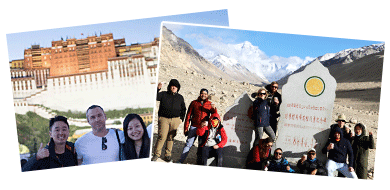
Tibet Cycling Travel Review from our 33rd Tour Group in April, 2016
Lhasa-Namtso Cycling Review of the 44th Group in April, 2016
I am a tour guide in Tibet an was Born in Kham Tibet, I am the father of 2 little girls, bachelor's degree. I have more than 7-years experience of being a tour guide in Tibet. I am a warm, friendly, knowledgeable and attractive guy.
Related Articles & Posts


0 Comment ON "Cycling in Tibet"