 Search
 Pioneer of Tibet Tourism for Overseas Travelers since 1984!

Trekking in Tibet and Nepal: What Is the Difference and How to Choose?


Situated on either side of the Himalayas, Tibet and Nepal offer some of the world’s most spectacular trekking adventures, but with very different experiences.
Nepal offers greater trekking freedom and a wider variety of routes. You can trek from village to village, stay in traditional teahouse lodges, and explore famous regions such as Everest and Annapurna on a relatively affordable budget.
Tibet, by contrast, offers a more remote and culturally immersive high-altitude adventure. You can combine trekking with Tibetan monasteries, the sacred Mt. Kailash pilgrimage, and vast Himalayan landscapes. Trekking in Tibet also requires more planning ahead, as overseas travelers need permits and travel as part of a guided tour.
In this guide, we’ll compare trekking in Tibet and Nepal, including the best treks, scenery, altitude, difficulty, permits, costs, weather, and accommodation, so you can understand the key differences and decide which destination is right for you.
Trekking in Tibet and Nepal: What’s the Difference?
5 Best Treks in Tibet: From Mount Kailash to Everest
5 Best Treks in Nepal: From Everest to Annapurna
Tibet Everest Base Camp Trek vs. Nepal Everest Base Camp Trek: Which Is Right for You?
How Difficult Is Trekking in Tibet and Nepal?
How to Acclimatize for Trekking in Tibet and Nepal?
What Is the Best Time to Trek in Tibet and Nepal? April to May, Sep to Nov
What Are the Permit and Travel Rules for Trekking in Tibet and Nepal?
What Should You Pack for Trekking in Tibet and Nepal?
Can You Combine Trekking in Tibet and Nepal in One Trip?
More FAQs about Trekking in Tibet and Nepal
Conclusion: Start Planning Your Trekking Adventure in Tibet and Nepal with Us Today!
Trekking in Tibet and Nepal: What’s the Difference?
While Tibet and Nepal share the Himalayas, trekking in the two destinations feels very different.
Nepal offers the classic Himalayan trekking experience, with well-established trails connecting mountain villages and iconic teahouse lodges. You can choose from a huge variety of routes, from beginner-friendly walks to challenging high-altitude treks.
On the contrary, Tibet feels more remote, high-altitude, and culturally immersive. Tibet trekking often combines vast plateau landscapes with holy monasteries, sacred mountains & lakes, and Tibetan pilgrimage traditions. Besides, visiting Tibet is also more regulated, requiring permits and an organized tour for international travelers.
Tibet vs. Nepal Trekking: Which Is Right for You?
| What to Compare | Trekking in Tibet | Trekking in Nepal |
|---|---|---|
| Trekking Style | More remote and expedition-like; often combines overland sightseeing with multi-day trekking. | More classic Himalayan trail trekking, usually walking from village to village. |
| Landscape & Scenery | Vast Tibetan Plateau, sacred mountains, turquoise alpine lakes, ancient monasteries, open valleys and panorama of epic Himalayan peaks | Deep valleys, forests, terraced farmlands, mountain villages, glaciers and dramatic Himalayan peaks |
| Altitude | Generally higher from the beginning, Lhasa (3,650m), with many high passes around 5,000m | Usually starts lower from the Kathmandu Valley (1,400m) and gradually climbs to higher elevations. |
| Difficulty | Moderate to challenging: generally higher starting altitude; thin air and remote terrain are the main challenges. | Easy to very challenging: much wider choice, from beginner-friendly trails to strenuous high-pass treks |
| Accommodation | Hotels before and after treks; humble guesthouses or camping on remote routes | Extensive network of teahouses and mountain lodges on popular routes |
| Culture & Local Experience | Deep Tibetan Buddhist and pilgrimage culture, with monasteries, sacred sites, traditional villages, and many chances to meet welcoming local Tibetans. | Diverse Himalayan cultures, including Sherpa, Gurung, Tamang, and other communities, with plenty of chances to meet locals in villages and teahouses. |
| Permits & Independent Trekking | More regulated; Overseas travelers need a Tibet Travel Permit and must join an organized tour with a licensed guide. Independent trekking is not permitted. | More flexible; permit and guide requirements vary by trekking area, and many popular routes require a licensed guide and TIMS card (trekker registration card). |
| Cost & Logistics | Usually more expensive, with required permits, guides, tour vehicles, and more complex logistics; remote treks may also need yaks and herders. | Generally more budget-friendly, with a well-developed network of trails, teahouses, and trekking services. |
| Iconic Treks | Mount Kailash Trek, Gama Valley Trek, Old Tingri to Everest Base Camp Trek, Ganden to Samye Trek, and other remote high-altitude routes | Everest Base Camp Trek, Annapurna Circuit, Annapurna Base Camp Trek, Langtang Valley Trek, and Manaslu Circuit Trek |
| How to Choose | Choose Tibet if you look for remote adventures, deep Tibetan culture, sacred pilgrimages, and vast high-altitude landscapes. | Choose Nepal if you prefer classic Himalayan trekking, a wider choice of routes, and greater flexibility. |
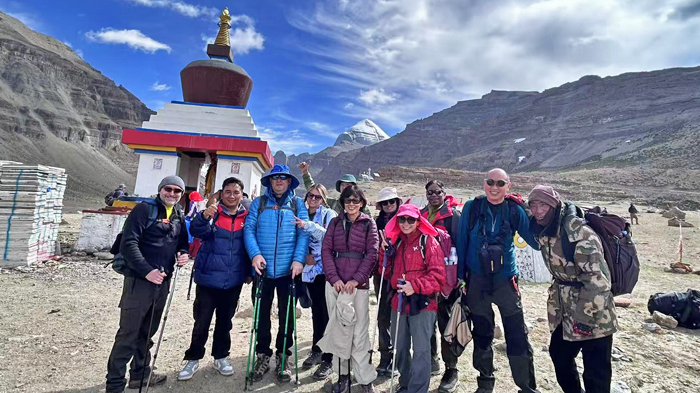 Our guests enjoy the sacred Mount Kailash kora trek in remote western Tibet.
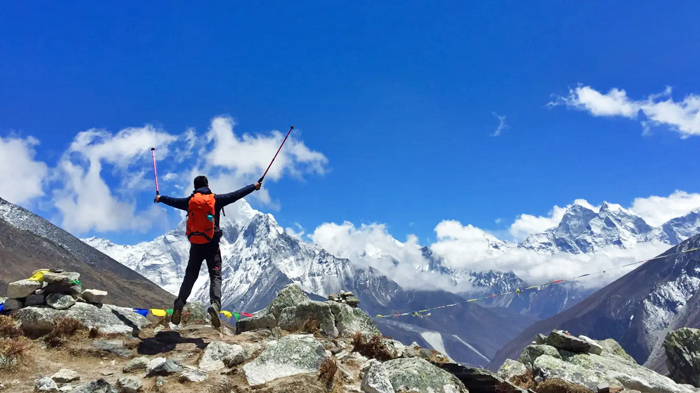 Travelers experience the classic Everest Base Camp trek in Nepal.
5 Best Treks in Tibet: From Mount Kailash to Everest
Tibet offers some of the most extraordinary high-altitude trekking experiences in the Himalayas.
You can walk alongside devout local pilgrims around sacred Mount Kailash, trek through remote valleys beneath Mount Everest, or follow an ancient trail between the historic Ganden and Samye monasteries. Farther north, you can cross vast grasslands where Tibetan nomads still graze their yaks on the way to sacred Namtso Lake.
As a local Tibetan guide with years of experience guiding overseas travelers across Tibet, here’s a quick comparison of five of the best treks in Tibet:
| Treks in Tibet | Best For | Duration | Distance | Difficulty | Highest Point | Best Season |
|---|---|---|---|---|---|---|
| Mount Kailash Kora | Tibetan pilgrimage, purify one’s sins and gain blessings | 3 days | 52km | Moderate to challenging | Dolma La Pass (5,630 m) | May to Jun, Sep to Oct |
| Gama Valley Trek | Explore remote Everest wilderness | 8 days | 80 km | Moderate to challenging | Nangma La (5,344 m) | April to Jun, Sep to Oct |
| Old Tringri to Everest Base Camp Trek | Discover Everest & Himalayan scenery | 4 days | 70km | Moderate | Lamna-La Pass (5,100 m) | Apr to Jun, Sep to Oct |
| Ganden to Samye Trek | Tibetan culture & ancient pilgrimage route | 4 days | 80km | Moderate to challenging | Shuga La Pass (5,250m) | Mid-May to mid-Oct |
| Namtso Lake Trek | Nomadic landscapes & holy lake | 3 days | 60km | Moderate to challenging | Kyang La Pass (5,330m) | May to Oct |
1. Mount Kailash Trek: Best Spiritual Trek in Tibet
If you are looking for the ultimate spiritual trek in Tibet, look no further than the legendary 3-day Mount Kailash trek, a deeply meaningful pilgrimage around Tibet’s most sacred mountain in remote western Tibet.
Revered by Tibetans, Hindus, Jains, and Bon followers as the “Center of the Universe”, Mount Kailash has drawn pilgrims for centuries. Walking the sacred kora is believed to cleanse sins of a lifetime and bring spiritual blessings, making the journey much more than an ordinary mountain trek.
You will walk alongside devoted pilgrims, some completing full-body prostrations, as you make the 52 km circuit around Mount Kailash. With our well-paced itinerary, experienced local Tibetan guide, porter support, and oxygen supplies, you can take on this remarkable high-altitude pilgrimage smoothly with peace of mind.
- Route: Darchen - Dirapuk Monastery - Dolma La Pass - Zutulpuk Monastery - Darchen
- Scenery: Mount Kailash’s dramatic north face, high-altitude valleys, prayer flags, sacred sites, and the vast landscapes of western Tibet
- Accommodation: Simple guesthouses at Dirapuk and Zutulpuk; facilities are basic.
- Best for: Spiritual travelers, culture lovers, Buddhists, and photographers.
- Good to know: Amon our guests, Day 2 is the toughest as you cross Dolma La Pass (5,630 m). Our experienced local Tibetan guide and a porter will be by your side throughout the trek, offering oxygen supplies and support whenever you need it.
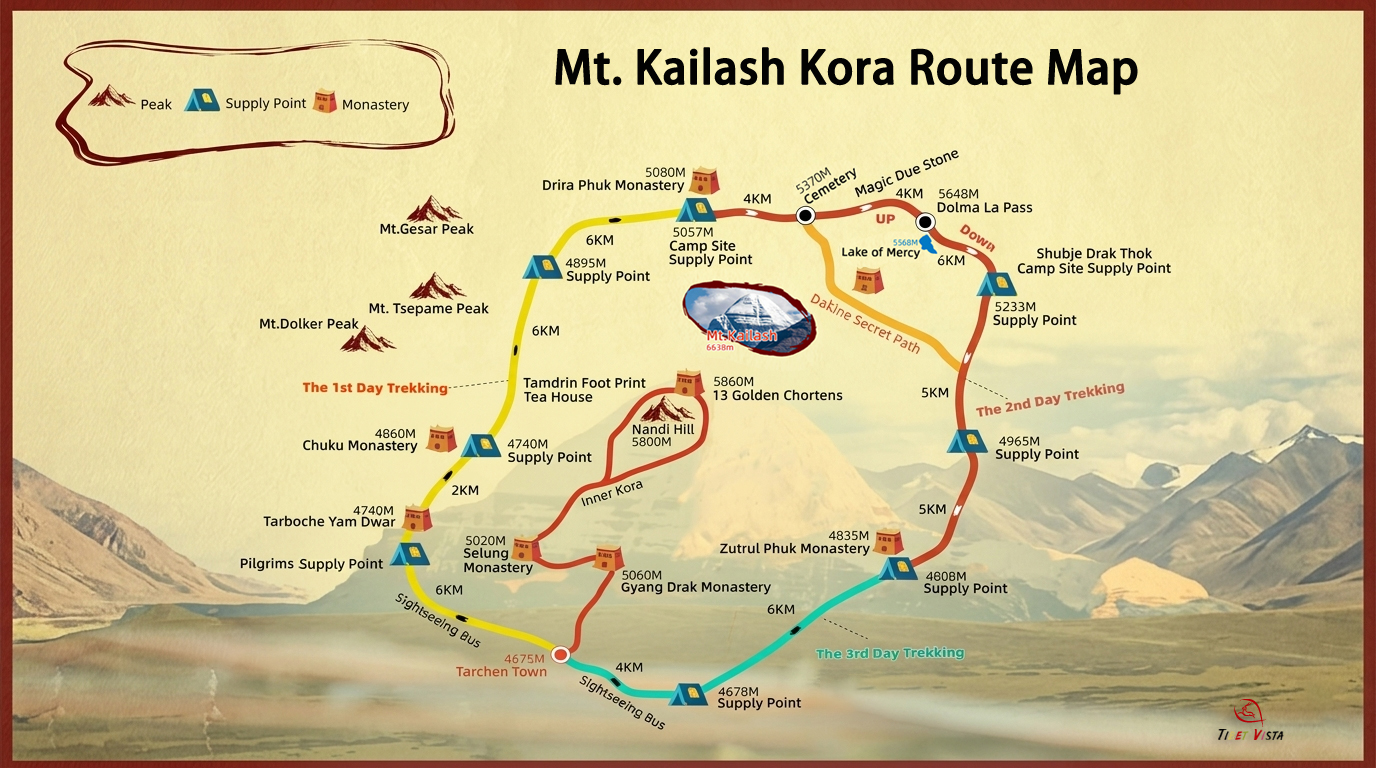 (Simple click to enlarge the map)
Map of the classic 3-day Mount Kailash kora trek route in Tibet.
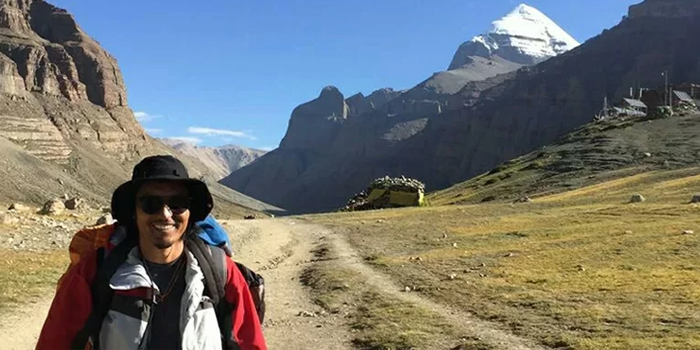

Experience Tibet’s ultimate pilgrimage trek on our classic 15-day Lhasa to Mt. Kailash and Manasarovar small group tour.
2. Gama Valley Trek: Best Trek on the Eastern Side of Mount Everest
Hidden on the remote eastern side of Mount Everest, Gama Valley is one of Tibet’s most spectacular wilderness treks. The roughly 80 km route takes you deep into the Mount Everest Nature Reserve, far from the more frequently visited northern side of Everest.
The biggest reward is the Himalayan scenery. Along the way, you can enjoy close-up views of Mount Everest, Lhotse, and Makalu, together with pristine forests, alpine valleys, glaciers, and high mountain passes. A highlight is Tshorim Tsho (a beautiful alpine lake), where, in clear weather, this holy lake beautifully reflects a magnificent line of snow-covered Himalayan peaks.
- Route: Youpa - Showo-tso - Dolshang - Tangsung - Paltang - Eastern Slope of Everest Base Camp - Tshorim Tsho - Lhundupling - Youpa
- Scenery: Alpine meadows, rivers, wetlands, glaciers, wildflowers, moraine valleys and dramatic views of Everest's eastern face.
- Accommodation: Mainly camping, as tourist facilities along the route are very limited.
- Best for: Experienced trekkers, photographers and adventure travelers looking for solitude and untouched Himalayan wilderness.
- Good to know: This is a remote, expedition-style trek. Good fitness, previous trekking experience and careful acclimatization are strongly recommended.
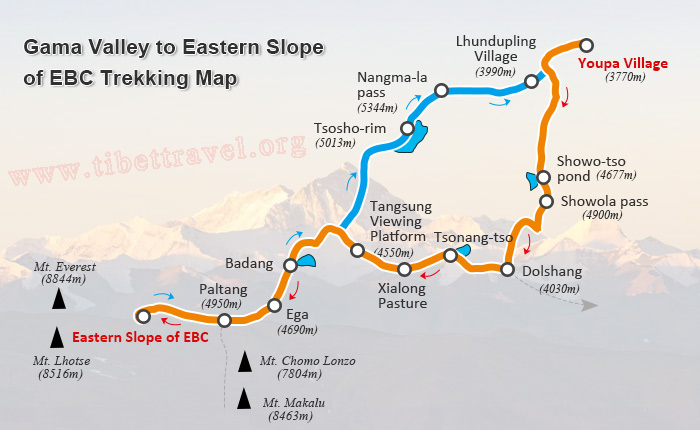 Map of the classic 8-day Gama Valley trek in eastern Mount Everest in Tibet.
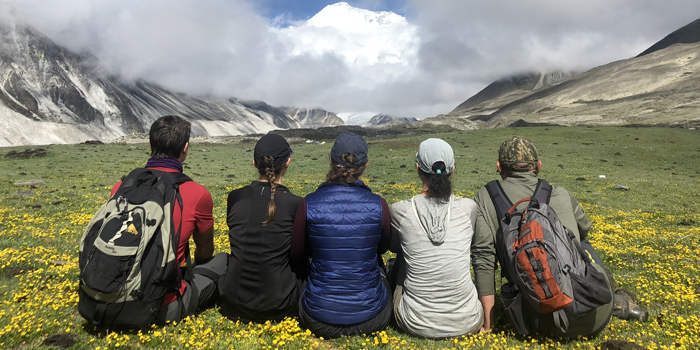
Trek through Gama Valley near Mt. Everest for breathtaking views of snow-capped Himalayan peaks.
3. Old Tingri to Everest Base Camp Trek: Best for Himalayan & Everest Scenery
If you want to trek to Mount Everest while watching the vast Himalayan landscapes of Tibet gradually unfold before your eyes, the classic Old Tingri to Everest Base Camp trek is your best choice. Starting from Old Tingri (Gangga Town) at around 4,300 m, this roughly 70 km trek takes about four days to reach Everest Base Camp and Rongbuk Monastery (5,154m), the world’s highest monastery.
Much of the route follows open highland tracks, gravel paths, and gentle slopes rather than steep terrain. Along the way, you will cross several high passes and enjoy sweeping views of Mount Everest and other mighty Himalayan peaks, remote Tibetan villages, pastoral valleys, and the peaceful Himalayan wilderness.
- Route: Old Tingri (Gangga) - Longjiang Village - Lamna-la - Zombuk Village - Everest Base Camp - Rongbuk Monastery
- Scenery: Mount Everest, Cho Oyu, broad Himalayan valleys, remote Tibetan villages, and high-altitude wilderness.
- Accommodation: Mainly camping, with yaks used to carry luggage and camping equipment.
- Best for: Everest lovers, photographers, and trekkers seeking Himalayan scenery and remote Tibetan landscapes.
- Good to know: The terrain is not that difficult, but the entire trek is above 4,000 meters. Good acclimatization before setting out is essential.
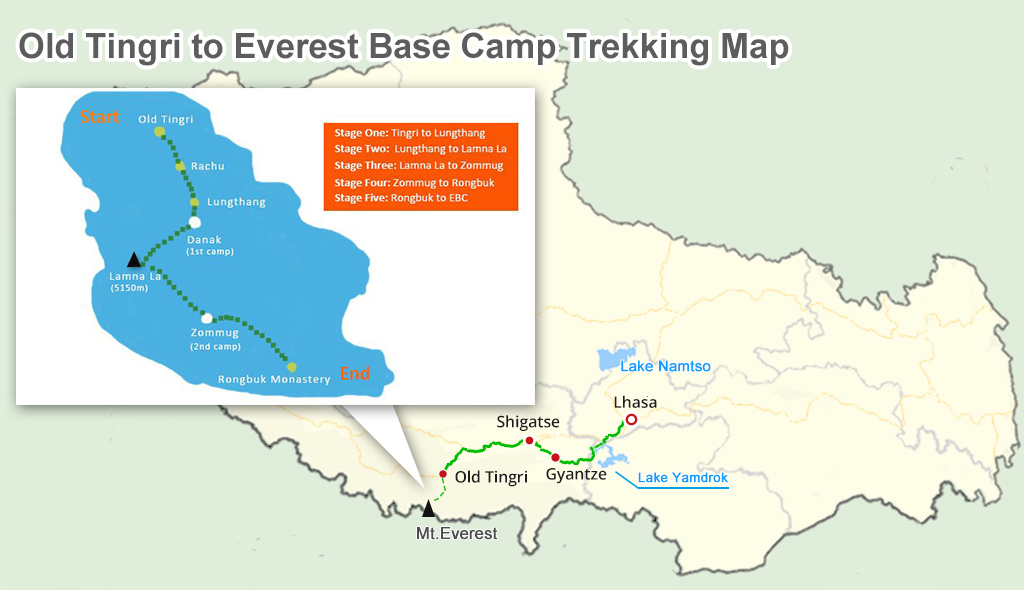 (Simple click to enlarge the map)
Map of the classic 4-day Old Tingri to Everest Base Camp trek in Tibet.
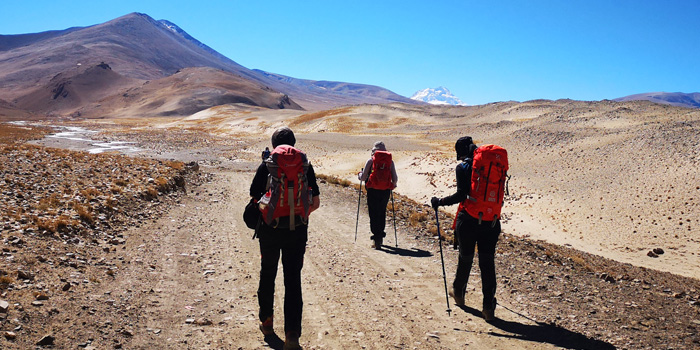
Trek from Old Tingri to Everest Base Camp for sweeping Himalayan views and Mt. Everest’s amazing North Face.
4. Ganden to Samye Trek: Best Classic Tibet Trek on an Ancient Pilgrimage Route
The Ganden to Samye trek is one of Tibet’s classic high-altitude treks, combining spectacular mountain scenery with centuries of Tibetan Buddhist history.
It connects Ganden Monastery, the first Gelug monastery around Lhasa, with Samye Monastery, the first Buddhist monastery in Shannan Prefecture, the cradle of Tibetan civilization.
Covering around 80 km over 4 days, the trek leads you through alpine valleys, summer pastures, peaceful highland lakes, and remote herders’ camps. Along the way, you will cross high mountain passes draped with Tibetan prayer flags, adding a strong sense of pilgrimage to the journey.
- Route: Ganden Monastery - Tsubshi - Yama-do - Shuga La Pass - Chitu La Pass - herders' camps - Changtang - Yemalung Hermitage - Samye Monastery
- Scenery: High mountain passes, streams, alpine meadows, valleys, yak pastures, and hidden Tibetan villages.
- Accommodation: Mainly camping during the trek.
- Best for: Culture lovers, experienced trekkers, and travelers interested in Tibetan Buddhism and pilgrimage.
- Good to know: With an average altitude above 4,500 m and two passes above 5,000 m, good acclimatization and reasonable fitness are essential.
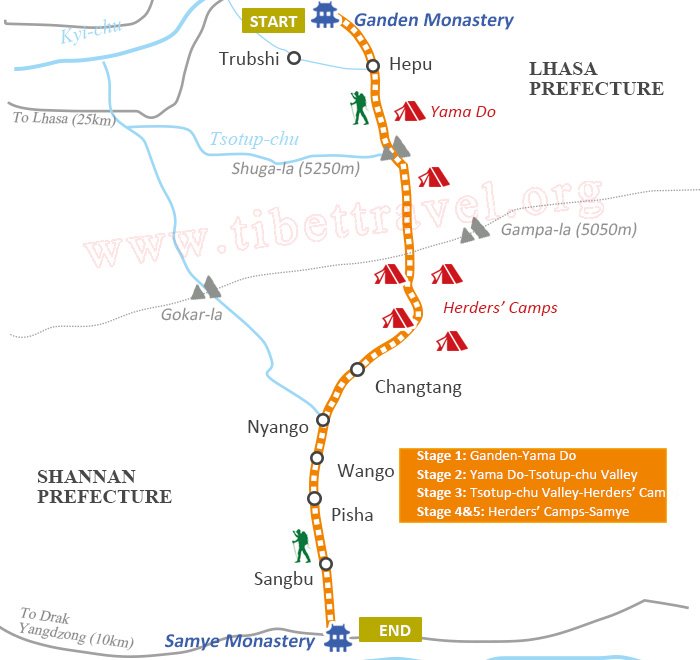 Map of the classic 4-day Ganden to Samye trek in Tibet.

Trek from Ganden to Samye along an ancient pilgrimage route through spectacular high-altitude landscapes.
5. Namtso Lake Trek: Best for Tibetan Nomadic Landscapes
If you are drawn to wide-open grasslands, Tibetan nomadic culture, and sacred highland lakes, the classic 3-day Namtso Lake Trek from Damxung should be your go-to choice.
This scenic trek takes you from the Nyenchen Tanglha region toward the shores of heavenly Namtso Lake, crossing remote alpine landscapes traditionally used by Tibetan nomads.
Along the way, you may encounter grazing yaks and sheep, Tibetan nomads’ camps, sweeping alpine meadows, and snow-capped Nyenchen Tanglha peaks, before descending toward the vast Qiangtang grasslands and the brilliant blue waters of Namtso Lake.
- Route: Damxung area - Nyenchen Tanglha valleys and grasslands - Kyang La Pass - Namtso Lake.
- Scenery: Snow-capped Nyenchen Tanglha mountains, alpine valleys, yak pastures, vast grasslands, nomadic landscapes and the deep-blue waters of Namtso.
- Accommodation: Mainly camping during the trek.
- Best for: Nature lovers, photographers and travelers interested in Tibetan nomadic landscapes and remote plateau scenery.
- Good to know: Since the route stays between 4,300 and 4,800m, proper acclimatization at Lhasa (3,650 m) and Damxung (4,300 m) is important. Our local Tibetan guide and yak caravan will support you along the way, carrying camping gear and supplies.
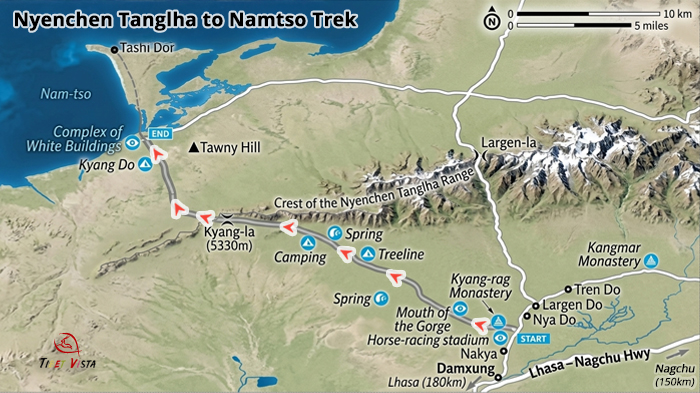 Damxung to Namtso Lake Trek map via Nyenchen Tanglha Mountains.

Trek across nomadic lands and snow-capped Nyenchen Tanglha peaks to reach the heavenly shores of Namtso Lake.
5 Best Treks in Nepal: From Everest to Annapurna
From the world-famous Everest Base Camp Trek to walking through the deep valleys of the Annapurna region and beyond, trekking in Nepal offers an incredible variety of Himalayan experiences.
You can follow legendary trails through Sherpa villages and welcoming teahouses, cross dramatic mountain passes, or venture into quieter regions where Tibetan-influenced cultures and centuries-old monasteries are still part of everyday life.
Here are five of the best treks in Nepal, each offering something different for your Himalayan adventure.
| Treks in Nepal | Best For | Duration | Distance | Difficulty | Highest Point | Best Season |
|---|---|---|---|---|---|---|
| Everest Base Camp Trek | First-time Everest seekers | 12 to 14 days | 130 km | Moderate to challenging | Kala Patthar (5,545 m) | Mar to May, Sep to Nov |
| Annapurna Circuit | Diverse Himalayan landscapes | 15 to 21 days | 160 to 230 km | Moderate to challengingg | Thorong La Pass (5,416 m) | Mar to May, Sep to Nov |
| Annapurna Base Camp Trek | A shorter classic Himalayan trek | 10 to 12 days | 70 to 110 km | Moderate | ABC (4,130 m) | Mar to May, Sep to Nov |
| Langtang Valley Trek | Easy access from Kathmandu | 7 to 8 days | 70 to 90 km | Moderate | Tserko Ri (4,984 m) | Mar to May, Sep to Nov |
| Manaslu Circuit | A quieter alternative to Everest & Annapurna | 14 to 18 days | 170 to 180 km | Challenging | Larkya La Pass (5,160 m) | Mar to May, Sep to Nov |
1. Everest Base Camp Trek: Most Classic Trek for First-Time Everest Seekers
If seeing Mount Everest up close has always been on your travel list, the Everest Base Camp Trek in Nepal is a classic place to start. Beginning in Lukla, the trail follows the serene valleys through Namche Bazaar, Tengboche, and other traditional Sherpa villages before reaching Everest Base Camp (5,364m).
Interestingly, you can’t actually see the summit of Everest from Nepal Everest Base Camp, as nearby mountains and ridges, particularly Nuptse, block the view. For the iconic panorama of Everest, Kala Patthar is the place you should go.
So, the real magic of the Everest Base Camp Trek goes far beyond reaching Base Camp. Along the way, you’ll cross suspension bridges, stay in mountain teahouses, visit Buddhist monasteries, and trek deeper into a spectacular world of glaciers and towering Himalayan peaks.
- Route: Lukla - Phakding - Namche Bazaar - Tengboche - Dingboche - Lobuche - Gorak Shep - Everest Base Camp – Lukla
- Scenery: Everest, Lhotse, Nuptse, Ama Dablam, glaciers, deep valleys and Sherpa villages
- Accommodation: Well-established teahouses and mountain lodges along the trail
- Best For: First-time visitors who want the iconic Everest trekking experience
- Good to Know: The classic Everest Base Camp trek in Nepal begins with a flight from Kathmandu to Lukla, the gateway to the EBC trail.
During the peak trekking seasons (May to March, Sep to Nov), Lukla flights are usually operated from Ramechhap, so allow extra time for the road transfer. Once on the trail, don’t rush your ascent. Plan acclimatization days in Namche Bazaar and Dingboche before heading higher.
 (Simple click to enlarge the map)
Map of the classic Everest Base Camp trek from Lukla in Nepal.
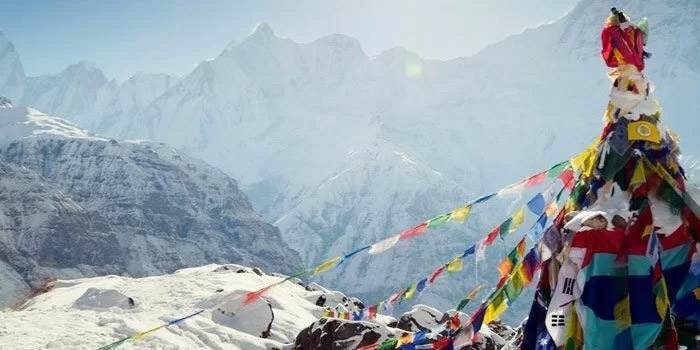
Trek to Everest Base Camp for an unforgettable first encounter with Mt. Everest and the Himalayas in Nepal.
2. Annapurna Circuit: Best for Diverse Himalayan Landscapes
Of all the treks in Nepal, the Annapurna Circuit stands out for its incredible variety of Himalayan landscapes. You make an epic journey around the Annapurna massif, passing through ever-changing scenery, from green valleys and traditional villages to high alpine terrain and the dry, Tibetan-influenced landscapes north of the mountains.
One of the biggest highlights of the trek is crossing Thorong La Pass at 5,416 meters, the highest point of the journey, before descending to sacred Muktinath. Along the way, you’ll see the scenery change dramatically from one section of the trail to the next, which is exactly what makes the Annapurna Circuit so special.
- Route: Dharapani - Chame - Pisang - Manang - Yak Kharka - Thorong Phedi - Thorong La - Muktinath - Jomsom
- Scenery: Annapurna, Dhaulagiri, Manaslu, deep valleys, forests, alpine terrain and trans-Himalayan desert
- Accommodation: Teahouses and mountain lodges
- Best For: Trekkers who want to experience a wide variety of Himalayan landscapes and local cultures in one epic journey.
- Good to Know: Roads now reach parts of the traditional Annapurna Circuit, so our local Nepali guides use quieter walking trails away from the main road whenever possible, giving you a more enjoyable and authentic trekking experience.
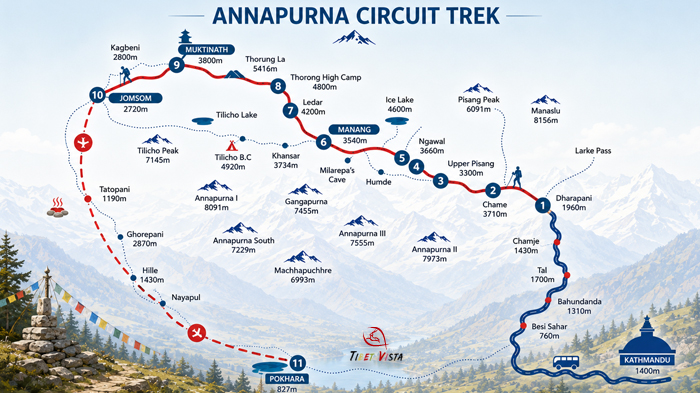 Map of the classic Annapurna Circuit trekking route in Nepal.

Trek the Annapurna Circuit through lush valleys, high mountain passes, and dramatic Himalayan landscapes.
3. Annapurna Base Camp Trek: Best Shorter Classic Himalayan Trek
If you want to experience a classic Himalayan trek in Nepal but don’t have two weeks to spare, the Annapurna Base Camp trek is one of the best choices.
The trail takes you through traditional villages and lush forests, with the mountain scenery becoming more dramatic as you climb toward the spectacular Annapurna Sanctuary.
When you finally reach Annapurna Base Camp at 4,130 meters, you’ll be surrounded by a breathtaking circle of Himalayan peaks, including Annapurna I, Machhapuchhre (Fishtail), and beyond. It’s the kind of moment that makes every step of the journey feel worthwhile.
- Route: Pokhara - Birethanti - Ulleri - Ghorepani - Tadapani - Chhomrong - Dovan - Deurali - Machhapuchhre Base Camp - Annapurna Base Camp - Sinuwa - return
- Scenery: Annapurna I, Machhapuchhre, Hiunchuli, waterfalls, Rhododendron forests and the Annapurna Sanctuary
- Accommodation: Comfortable basic teahouses and mountain lodges
- Best For: Travelers looking for a shorter classic Himalayan trek than Everest Base Camp or the Annapurna Circuit.
- Good to Know: Although the Annapurna Base Camp trek is shorter than many classic Himalayan treks, you’ll still reach 4,130 meters, so take your time as you climb higher.
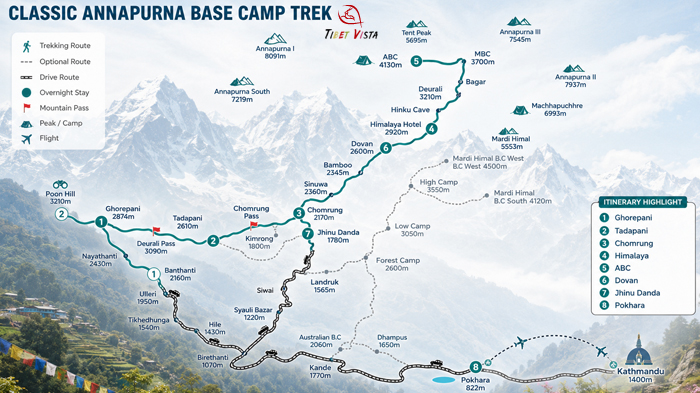 Map of the classic Annapurna Base Camp trek in Nepal.
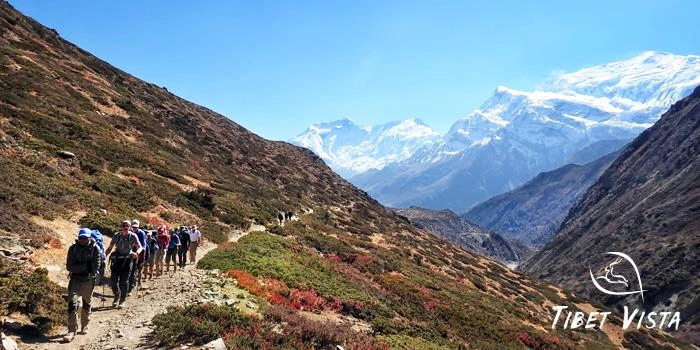
Trek to Annapurna Base Camp for breathtaking Himalayan views on a classic short adventure.
4. Langtang Valley Trek: Best Accessible Trek from Kathmandu
Just a short journey from Kathmandu, the Langtang Valley Trek offers one of Nepal’s most accessible Himalayan trekking experiences. It’s a great choice if you have limited time but still want to enjoy spectacular mountain scenery, peaceful trails, and traditional Himalayan villages.
Starting from Syabrubesi, you’ll follow the beautiful Langtang Valley through peaceful forests and traditional Tamang villages before reaching Kyanjin Gompa, a small mountain settlement surrounded by snow-capped peaks. From here, you can hike up Kyanjin Ri or Tserko Ri for some of the best panoramic views of the Langtang Valley and the surrounding Himalayas.
- Route: Syabrubesi - Sherpagaon - Lama Hotel - Langtang Village - Kyanjin Gompa - Kyanjin Ri or Tserko Ri - return to Syabrubesi
- Scenery: Langtang Himal, forests, rivers, alpine meadows, glaciers and mountain villages
- Accommodation: Local teahouses and lodges
- Best For: Travelers with limited time and families looking for a shorter Himalayan trek with easy access from Kathmandu.
- Good to Know: Langtang Valley Trek is much more than a shorter alternative to Everest. Its quieter valleys, Tibetan-influenced Tamang villages, and rich Buddhist heritage give the trek a unique character of its own.
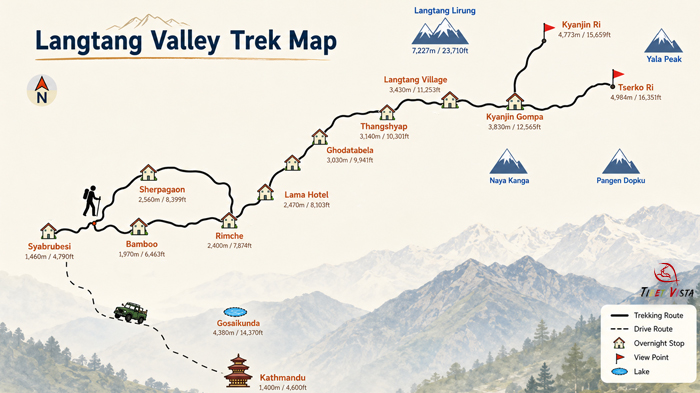 Map of the classic Langtang Valley Trek from Syabrubesi in Nepal.

Trek through enchanting Langtang Valley for stunning Himalayan views within easy reach of Kathmandu.
5. Manaslu Circuit: Best Quieter Alternative to Everest & Annapurna
If you’re an experienced trekker drawn to spectacular Himalayan scenery, quieter trails, and a more remote mountain experience, the Manaslu Circuit Trek is an excellent choice.
Following the Budhi Gandaki River, the trail takes you from lush green valleys and forests into increasingly dramatic high-mountain scenery. As you climb higher, you’ll pass Tibetan-influenced villages and Buddhist monasteries before reaching the spectacular Larkya La Pass (5,160 m). It’s a beautiful adventure where both the landscape and local culture gradually change with every step.
- Route: Machha Khola - Jagat - Deng - Namrung - Shyala - Samdo - Dharamsala - Larkya La - Bhimthang - Dharapani
- Scenery: Mount Manaslu, deep river gorges, forests, glaciers, high passes and remote villages
- Accommodation: Mostly simple teahouses and lodges
- Best For: Trekkers seeking a quieter, more adventurous alternative to the Everest and Annapurna classics
- Good to Know: As Manaslu lies in a restricted region near the China border, you’ll need a special trekking permit and must arrange your trek through a registered and local travel agency like us. It takes a little more planning than many classic short treks in Nepal. That’s why it helps keep the Manaslu Circuit quieter and less crowded.
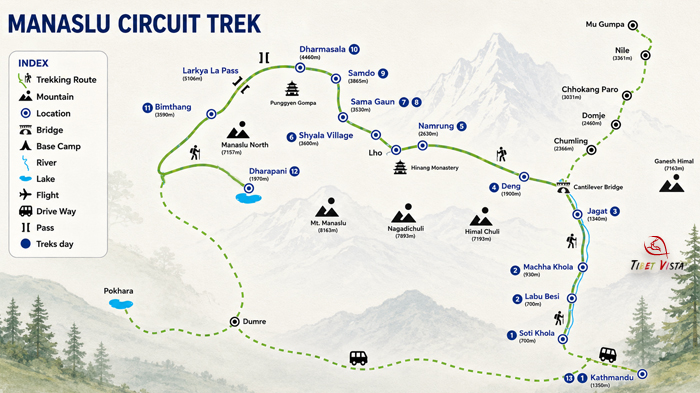 Map of the classic Manaslu Circuit Trek around Mount Manaslu in Nepal.
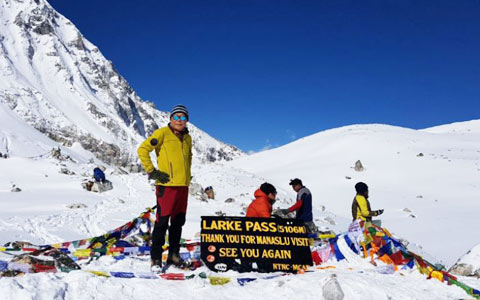
Trek the quieter Manaslu Circuit for dramatic Himalayan scenery and fewer crowds.
Insider Tips: Trekking policies and route availability in Tibet and Nepal may change from time to time. Please email us to check whether your preferred trek is available before making your travel plans.
Tibet Everest Base Camp Trek vs. Nepal Everest Base Camp Trek: Which Is Right for You?
The Tibet Everest Base Camp Trek and Nepal Everest Base Camp Trek offer two utterly different ways to trek through the Himalayas and experience Mount Everest up close.
The right choice depends on the kind of Everest experience you are looking for:
- Choose Tibet: If you want a more remote and adventurous trek with spectacular, unobstructed views of Mount Everest’s North Face, vast high-altitude landscapes, remote Tibetan villages, and sweeping Himalayan panoramas.
- Choose Nepal: If you prefer the classic Everest trekking experience, with changing alpine scenery, vibrant Sherpa culture, traditional mountain villages, and comfortable teahouses along the trail.
Tibet EBC Trek vs. Nepal EBC Trek: Side-by-Side Comparison
| Feature | Tibet Everest Base Camp Trek | Nepal Everest Base Camp Trek |
|---|---|---|
| Everest View | Epic, unobstructed views of Everest’s North Face, with wide-open Himalayan panoramas | Everest is not visible from Base Camp itself; the classic panoramic view is from Kala Patthar |
| Scenery | Vast alpine grasslands, open valleys, remote Tibetan villages, and sweeping Himalayan panoramas | Forests, rivers, Sherpa villages, glaciers, suspension bridges, and high mountains |
| Trek Duration | 4 days trekking from Old Tingri to EBC | Around 12 to 14 days trek from Lukla to EBC, round trip |
| Distance | Around 70 km | Around 130 km (two-way) |
| Altitude & Difficulty | Trek starts high (4,300m to 5,200m). High altitude, moderate walking effort. | EBC is 5,364 m, with Kala Patthar around 5,545m; a longer trek with many climbing and descending. |
| Accommodation | Mainly camping, with simple guesthouses or hotels before and after the trek. | Many teahouses and mountain lodges, with more meal and accommodation choices. |
| Culture | Strong Tibetan Buddhist culture, remote Tibetan villages, and Rongbuk Monastery near Everest | Rich Sherpa culture, Buddhist monasteries, and lively mountain villages along the trail |
| Crowds & Vibe | Much quieter, with far fewer trekkers | One of Nepal’s most popular trekking routes and can be quite busy during peak seasons. |
| Cost | Generally more expensive due to permits, organized-tour requirements, guide, transport, and trekking logistics | Generally more budget-friendly, with a wider range of accommodation, food, and trekking options |
| Permits Required | Overseas travelers need a Tibet Travel Permit and other required travel documents, and must travel on an organized Tibet tour. | Trekkers need a Sagarmatha (Everest) National Park Entry Permit and a local Khumbu entry permit. |
| Best Time to Trek | April to May and September to October | March to May and October to November |
| Best For | Travelers seeking unobstructed views of Everest’s North Face, sweeping Himalayan panoramas, Tibetan culture, solitude and a more remote adventure | Travelers seeking a classic Himalayan trek, diverse landscapes, Sherpa culture, teahouse comfort and a more social trekking experience |
Bonus Tip: See Mount Everest Without Trekking
If you’re traveling with older parents or children and want to avoid a multi-day trek, Tibet EBC is a great choice.
Unlike Nepal EBC, Tibet Everest Base Camp can be reached by well-paved road, allowing you to travel from Lhasa to Mount Everest in our comfortable tour vehicle while enjoying spectacular Tibetan Plateau and Himalayan scenery along the way.
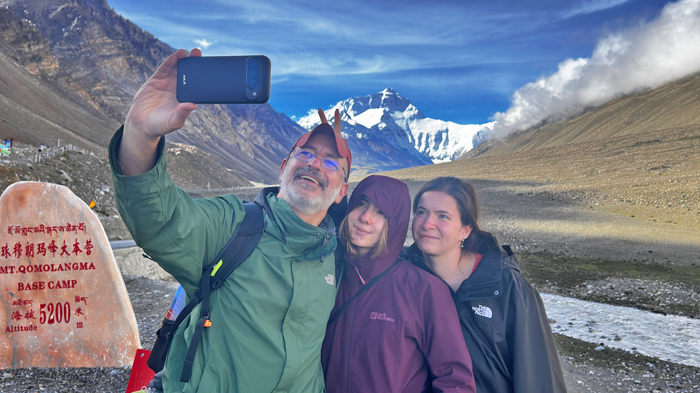 Our guests pose for photos with Mount Everest markers at Tibet EBC.

Enjoy our classic 8-day Lhasa to Everest Base Camp tour by comfortable tour bus and make your Everest dream come true.
How Difficult Is Trekking in Tibet and Nepal?
From beginner-friendly trails to challenging high-pass and multi-week adventures, both Tibet and Nepal offer a wide range of treks for different types of travelers to explore spectacular Himalayan landscapes and experience rich local cultures.
For many treks, as long as you are in good health, reasonably fit, and prepared for the altitude, you can find a trek that suits you best. Most importantly, allowing enough time for proper acclimatization is one of the keys to a safe and enjoyable trek in Tibet and Nepal.
Best Treks for Beginners in Tibet and Nepal
If this is your first time in Tibet and Nepal for trekking, these trails offer stunning views, cozy lodges or camps, and manageable distances.
- Drak Yerpa and Ganden Monastery Kora (Tibet, half-day trek): Easy options near Lhasa for enjoying hidden Tibetan Buddhist retreats and beautiful Lhasa valley and mountain scenery within a day. They are especially suitable as gentle walks after you have had time to acclimatize in Lhasa.
- Pabonka to Pubjoi Monastery trek (Tibet, day trek): A rewarding day hike near Sera Monastery in Lhasa that combines peaceful countryside, historic monasteries, and local Tibetan landscapes. It is a good choice if you want to experience a little more walking around Lhasa.
- Shalu to Nartang Trek (Tibet, 3-day trek): A great first multi-day trek through quiet valleys, traditional Tibetan villages, and monastery landscapes around Shigatse. With relatively manageable terrain and no extremely high mountain passes, it offers you a taste of Tibetan trekking adventure.
- Ghorepani Poon Hill Trek (Nepal, around 5 days): A great first Himalayan trek in the Annapurna region near Pokhara, with comfortable teahouses, moderate altitude, and beautiful sunrise views over snow-capped peaks.
- Langtang Valley Trek (Nepal, around 8 days): A popular beginner-friendly trek in Langtang National Park, north of Kathmandu, taking you through forests, traditional mountain villages, and peaceful valleys surrounded by snowy peaks.
- Mardi Himal Trek (Nepal, around 7 days): A good choice for fit beginners looking for a little more adventure in the Annapurna region near Pokhara, with forest trails, scenic ridges, and impressive close-up Himalayan views.
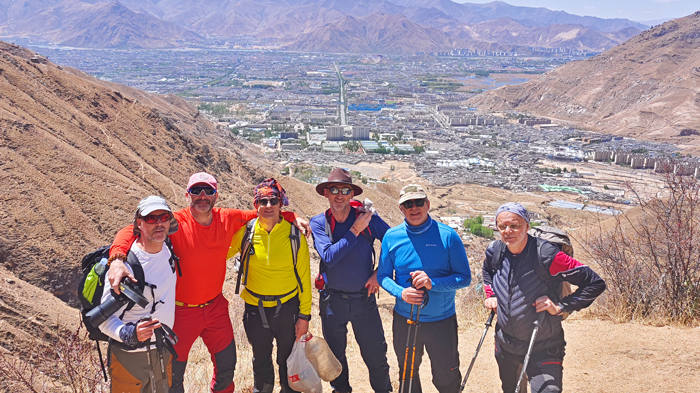 Our guests enjoy the scenic Ganden Kora and sweeping views over the Lhasa Valley.
Best Treks for Experienced Trekkers in Tibet and Nepal
- Mount Kailash Kora (Tibet, 3-day trek): The ultimate high-altitude pilgrimage in Tibet, circling sacred Mount Kailash and crossing the Dolma La Pass (5,630m) in remote western Tibet.
- Old Tingri to Everest Base Camp Trek (Tibet, 4 days): A remote and adventurous trek across the Tibetan Plateau to the north side of Mount Everest, with long walking days, camping along the route, and spectacular Himalayan views.
- Gama Valley Trek (Tibet, 8 days): An otherworldly wilderness adventure on the eastern slope of Mount Everest, taking you through remote valleys, alpine landscapes, and high mountain passes far from the usual tourist routes.
- Ganden to Samye Trek (Tibet, 4 days): A classic pilgrimage trek connecting two of Tibet’s most important monasteries, Ganden in Lhasa and Samye in Shannan, crossing two passes above 5,000 meters through beautiful alpine wilderness.
- Everest Base Camp Trek (Nepal, 12 to 14 days): Nepal’s most iconic trek through the Everest region, with Sherpa villages, mountain teahouses, glaciers, and increasingly dramatic Himalayan scenery on the way to Base Camp.
- Annapurna Circuit (Nepal, 15 to 21 days): A classic long-distance trek through the Annapurna region, taking you from green valleys and mountain villages to dramatic high-altitude landscapes before crossing the Thorong La Pass (5,416m).
- Annapurna Base Camp Trek (Nepal, 10 to 12 days): An immersive Himalayan trek into the Annapurna Sanctuary, taking you through forests and mountain villages before reaching Annapurna Base Camp, surrounded by towering snow-covered peaks.
- Manaslu Circuit (Nepal, 14 to 18 days): A quieter and more remote Himalayan trek around Mount Manaslu, combining traditional mountain villages, dramatic valleys, and the challenging Larkya La Pass (5,160m).
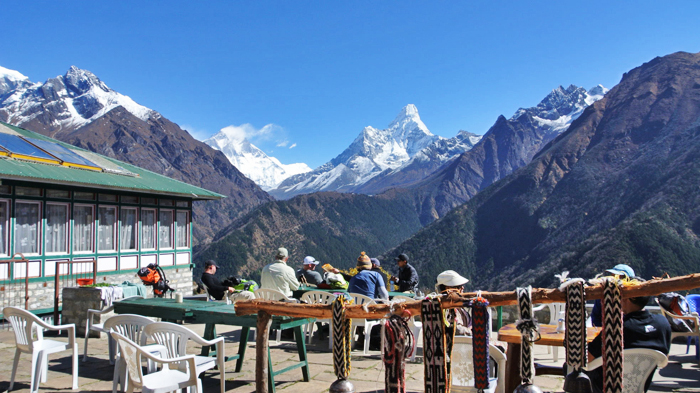 Cozy teahouse lodges welcome trekkers along the Everest Base Camp Trek in Nepal.
How to Acclimatize for Trekking in Tibet and Nepal?
When trekking in Tibet and Nepal, giving your body enough time to adjust to the altitude is one of the best ways to stay comfortable and reduce the risk of altitude sickness.
In Tibet, we usually recommend spending 2 to 3 days in Lhasa (3,650 m) before continuing to higher elevations. This gives your body valuable time to adjust and explore Tibet’s most iconic attractions before you travel or trek higher.
On the other hand, in Nepal, high-altitude routes such as the Everest Base Camp Trek usually include dedicated acclimatization days, commonly in Namche Bazaar and Dingboche, helping your body adjust as you gradually gain altitude.
From years of guiding travelers in Tibet, I’ve found that a few simple habits can make a big difference at high altitude:
- Ascend gradually: Once above 3,000 meters, aim to increase your sleeping altitude by only 300 to 500 meters per day. Take an extra acclimatization day after about every 1,000 meters gained, and when possible, trek high and sleep low.
- Walk at a comfortable pace: Trek slowly, take regular breaks, and don’t worry about keeping up with faster trekkers. Our experienced local Tibetan guide will keep an eye on how everyone is feeling and adjust the pace when needed.
- Stay hydrated and eat well: Drink water regularly and eat smaller, nutritious meals throughout the day rather than one heavy meal. Get plenty of rest as your body adjusts.
- Listen to your body: Headache, dizziness, nausea, or unusual fatigue can be signs of altitude sickness. Please don’t hesitate to tell our local guide if you feel unwell. They will check how you’re feeling, provide oxygen supplies, and help you take the safest next step.
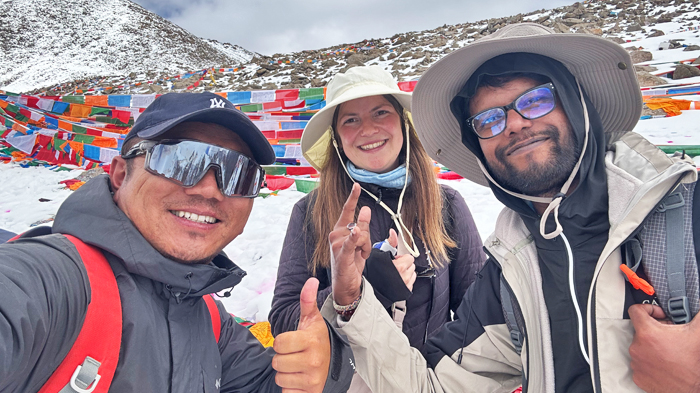 Our local Tibetan guide takes good care of our guests during the Mount Kailash kora.
Experience Tibet’s ultimate pilgrimage trek on our classic 15-day Lhasa to Mt. Kailash and Manasarovar small group tour.
What Is the Best Time to Trek in Tibet and Nepal? April to May, Sep to Nov
For most travelers, April to May and September to November are the best times to trek in Tibet and Nepal. These months offer clearer Himalayan skies, more stable weather, and comfortable daytime temperatures, making them ideal for trekking.
| Season | Tibet Trekking | Nepal Trekking | Best Choice |
|---|---|---|---|
| Spring (Apr to May) | Warming days, high passes open, wild peach blossoms blooming in the valleys. | Warm weather, Rhododendron blooms, good Himalayan views | Tibet & Nepal |
| Summer (Jun to Aug) | Lush green grasslands and mild temperatures, occasional rain | Monsoon season brings slippery trails, leeches, obscured mountain views. Upper Mustang is a good exception | Tibet |
| Autumn (Sep to Nov) | Clear skies, clearest Himalayan views, generally stable weather | Dry weather, clear skies, excellent Himalayan views | Tibet & Nepal |
| Winter (Dec to Mar) | Cold, with limited high-altitude trekking | Cold but quieter; lower-altitude treks are possible | Lower-altitude Nepal treks |
Autumn: One of the Best Times to Trek in Tibet and Nepal
Autumn (September to November) is one of the best times for trekking in both Tibet and Nepal. After the summer rains, the air is usually clearer, bringing excellent visibility and beautiful views of the Himalayas.
In Tibet, September and October are especially good for high-altitude treks such as the Mount Kailash trek, Ganden to Samye Trek, and trekking around Everest. Days are often sunny and relatively mild, although nights become colder as autumn progresses.
In Nepal, October and November are among the most popular trekking months. Trails around Everest, Annapurna, Manaslu, and Langtang generally enjoy dry weather, clear skies, and excellent mountain views.
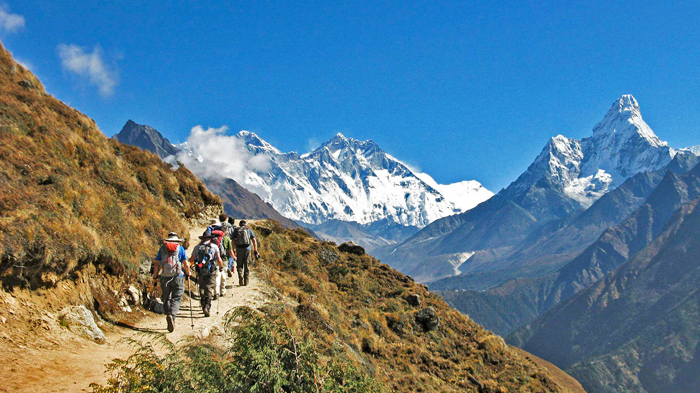 Crystal-clear October skies reward trekkers with stunning Himalayan views in Nepal’s Everest region.
Spring: Another Prime Time to Trek in Tibet and Nepal
Spring (April to May) is the second “golden window” for trekking in both Tibet and Nepal. The winter chill melts away, bringing pleasant daytime temperatures and stable, clear weather.
In Tibet, the high mountain passes clear up, and eastern Tibetan Plateau valleys like Nyingchi bloom with wild peach blossoms, while in Nepal, entire mountainsides explode in shades of crimson and pink as the giant Rhododendron trees come into bloom.
You can enjoy clear views of snow-covered Himalayan peaks in spring, with drier trails than in summer and warmer daytime temperatures than in winter. These pleasant conditions make long days on the trail much more comfortable.
Insider Tips: At higher elevations around Everest, Annapurna, and Mount Kailash, mornings and evenings can still be cold, with occasional snowfall, so be sure to pack warm layers.

Join our local experts to experience dreamy peach blossoms and explore amazing Laigu Glaciers in Nyingchi in early spring.
Summer: Very Different Trekking Conditions in Tibet and Nepal
From Summer (June to August), the trekking experience changes dramatically on the two sides of the Himalayas. If summer is your only travel window, Tibet offers more trekking options than Nepal.
In Tibet, summer can still be a rewarding time for trekking. Although July and August bring more rainfall, showers often come in the late afternoon or evening, while daytime temperatures are relatively mild and the high plateau turns beautifully green.
This is an especially scenic time to trek around Namtso Lake, where the Changtang grasslands are lush and green, yaks and sheep graze across the open plateau, and Tibetan nomadic life adds a unique local experience to your journey.
In Nepal, the summer monsoon brings frequent rain, humid conditions, muddy and slippery trails, clouds, and leeches at lower elevations. If clear Everest or Annapurna mountain views are your priority, spring or autumn is a much better choice.
Trek across nomadic lands and snow-capped Nyenchen Tanglha peaks to reach the heavenly shores of Namtso Lake.
Winter: Quiet Trails and Crisp Blue Skies in Tibet and Nepal
Winter (December to March) is a season for true peace-seekers who don’t mind bundling up in warm layers. The high mountain passes above 4,000 to 5,000 meters often receive heavy snow and experience freezing temperatures, making many high-altitude treks unavailable.
However, winter rewards travelers with some of the clearest blue skies, brightest sunshine, and quietest trails of the year, along with far fewer crowds and more affordable prices for hotels and transportation.
Whether you choose Tibet or Nepal, winter can still be a wonderful time for a more relaxed trekking experience. Lower-altitude routes, such as trails around the Lhasa Valley and eastern Tibet, or shorter treks in the lower areas of Nepal’s Everest region, can offer beautiful landscapes without the challenges of extreme high-altitude conditions.
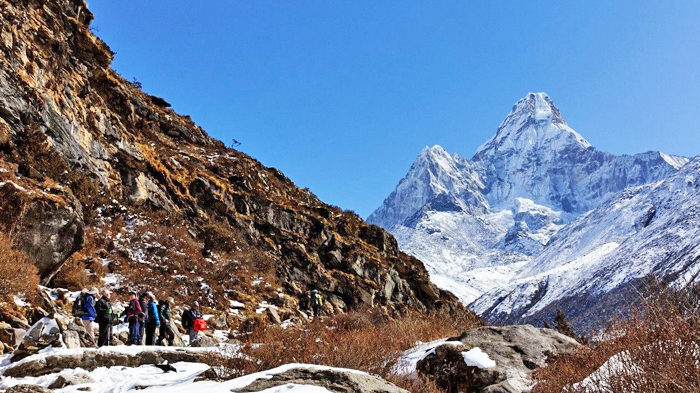 Trekkers enjoy quieter trails in Nepal’s lower Everest region during winter.
What Are the Permit and Travel Rules for Trekking in Tibet and Nepal?
Trekking in Nepal offers greater flexibility and more independent trekking options, while trekking in Tibet requires advance planning, Tibet travel permits, and a pre-arranged guided tour with a local Tibet travel agency like ours.
Tibet vs Nepal Trekking Permits: What Travelers Need to Know
| Feature | Trekking in Tibet | Trekking in Nepal |
|---|---|---|
| Can you trek independently? | No. Foreign travelers must join an organized tour with a licensed Tibet travel agency and a local guide. | Yes, more flexible, but many routes now require a registered guide or agency, especially in restricted areas. |
| Main permits | Tibet Travel Permit, plus additional permits depending on your route, such as border & military permits for areas like Mount Kailash and Everest regions. | Trekking permits, National Park or Conservation Area permits, and Restricted Area permits where required. |
| Who arranges permits? | Our local Tibet travel agency applies and organizes all required documents before arrival. | A government-approved Nepali trekking agency handles permits, guide arrangements, and local logistics. |
| Travel style | Organized Tibet trekking tours but can be private, customized, and flexible in small groups. | More independent trekking culture, with options from basic teahouse trekking to fully supported expeditions. |
| Best for | Travelers seeking remote landscapes, Tibetan culture, spiritual journeys, and a carefully organized high-altitude adventure. | Travelers seeking classic Himalayan trekking routes, mountain villages, teahouse experiences, and more trekking freedom. |
What Should You Pack for Trekking in Tibet and Nepal?
Packing smart is the key to enjoying a comfortable Himalayan trek. Whether you are trekking in Tibet or Nepal, travel light and bring only what you truly need.
The weather in the Himalayas can change quickly, so the best approach is to dress in layers. Bring a moisture-wicking base layer, a warm fleece or sweater, and a waterproof windproof jacket. A lightweight down jacket, warm hat, gloves, and quality trekking shoes are also essential for cold mornings, high passes, and chilly nights.
Don’t underestimate the high-altitude sun and strong mountain winds. At higher elevations, the thinner air allows stronger UV rays to reach you, so bring UV-protection sunglasses, high-SPF sunscreen, lip balm, and a buff, wide-brimmed hat, or scarf to protect your eyes and skin throughout the trek.
When you join our organized trek in Tibet or Nepal, our local guide and trekking team take care of the important logistics, from camping equipment and yaks and yak herders to porters and oxygen supplies when needed.
You can simply enjoy the journey and carry your personal items, such as water, snacks, medicine, travel documents, a camera, a power bank, and some cash for small expenses along the way.
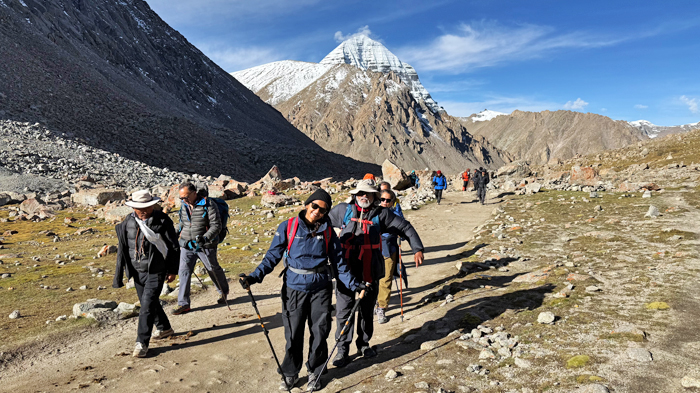 Our guests walk with trekking poles along the sacred Mount Kailash kora.
Experience Tibet’s ultimate pilgrimage trek on our classic 15-day Lhasa to Mt. Kailash and Manasarovar small group tour.
Can You Combine Trekking in Tibet and Nepal in One Trip?
Yes, absolutely! You can easily combine trekking in Tibet and Nepal into one unforgettable Himalayan adventure! In fact, many of our guests combine Tibet and Nepal in one unforgettable journey, because Tibet and Nepal offer two completely different but equally amazing experiences. Here is everything you need to know to make it happen smoothly.
Which Should You Trek First: Tibet or Nepal?
- Start with Tibet first if you want a smoother high-altitude experience: Tibet’s high plateau gives your body more time to begin acclimatizing before you enter Nepal’s trekking regions at similar or lower elevations.
For example, you can join our classic 13-day Lhasa to Kathmandu tour via Mt. Kailash. This journey allows you to explore Lhasa and Shigatse, the cultural heartland of Tibet, enjoy a scenic excursion to Tibet Everest Base Camp, and then travel west into remote Ngari to experience the legendary 3-day Mt. Kailash kora before continuing overland to Kathmandu with our smooth border transfer service.
- Start with Nepal first if trekking is your main priority: Nepal is the perfect place to begin, with well-established trekking routes, comfortable teahouse lodges, and options for beginners to experienced hikers.
After completing a classic trek like the Everest Base Camp Trek or Annapurna Trek, you can continue to Tibet by flight or overland route, where a mysterious world of Tibetan Buddhist culture, ancient monasteries, and sacred journeys like the Mt. Kailash kora awaits.
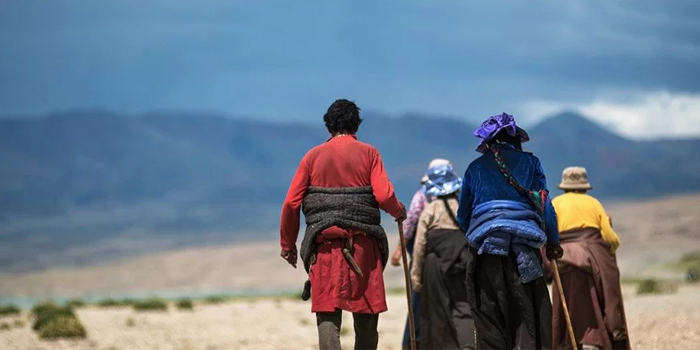
Travel overland from Kathmandu to holy Mt. Kailash and Lake Mansarovar and journey back to Nepal with our smooth border transfer.
Why Choosing a Local Tibet and Nepal Travel Agency Matters?
Combining trekking in Tibet and Nepal is an incredible Himalayan adventure, but it also requires careful planning of permits, border transfers, transportation, accommodation, experienced local guides, oxygen supplies, and remote trekking support.
As a local Tibet travel agency since 1984, with our headquarters in Lhasa and a branch in Kathmandu, Nepal, we make your journey easier with one-stop support from start to finish, saving you valuable time and unnecessary hassle.
From your first email inquiry to the completion of your journey, our local team supports every step of your Tibet and Nepal adventure, helping with Tibet travel permits, transportation, logistics, and unforgettable experiences such as the sacred Mount Kailash kora and iconic Everest Base Camp journeys on both sides of the Himalayas.
So, you can discover the stunning landscapes, deep-rooted cultures, and unforgettable Himalayan experiences of these two regions with confidence and peace of mind.
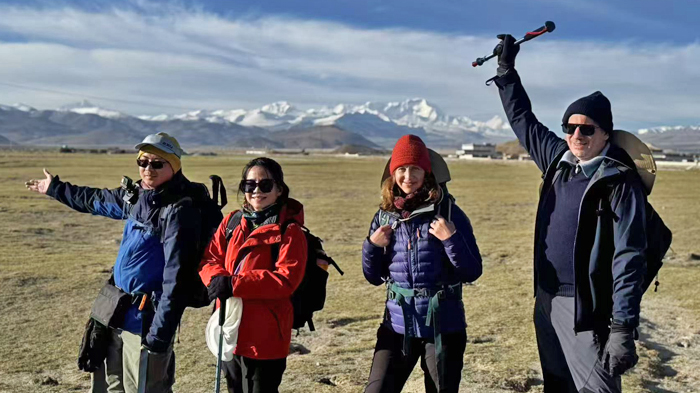 Trekking through Tibet and Nepal with our local guide’s expert care and prompt support.
More FAQs about Trekking in Tibet and Nepal
Q1: Is Tibet or Nepal Better for First-Time Trekkers?
For first-time trekkers, Nepal is often the easier place to start because it offers more established trekking routes, comfortable teahouse accommodation, more food choices, and a wide range of trails from easy walks to challenging high-altitude adventures.
Popular beginner-friendly options include the Ghorepani Poon Hill Trek, Langtang Valley Trek, and shorter sections of the Annapurna region, where you can enjoy beautiful Himalayan scenery without extreme altitude challenges.
Trekking in Tibet is also popular for first-time trekkers. With the right route, proper acclimatization, and the support of our experienced local guides, you can safely enjoy Tibet’s breathtaking landscapes and unique cultural experiences.
Short cultural treks around Lhasa, scenic hikes near Namtso Lake, or a guided Mount Kailash kora can be wonderful choices for travelers seeking a quieter Himalayan experience, breathtaking landscapes, and a deeper connection with Tibetan culture and traditions.
Q2: Is Trekking in Tibet Harder Than Nepal?
Yes, trekking in Tibet is generally more challenging than trekking in Nepal, mainly because of the higher starting altitude and more remote conditions.
Many areas of the Tibetan Plateau are above 4,000 meters, so travelers need more time to adjust to the thinner air. Even shorter routes around Lhasa require proper acclimatization before beginning the trek.
Nepal also offers demanding high-altitude adventures, including the Everest Base Camp Trek (5,364 m) and Annapurna Circuit (Thorong La Pass at 5,416 m). However, many Nepal trekking routes start at lower elevations and gradually climb through valleys, forests, and mountain villages, giving your body more time to adapt.
Whether you trek in Tibet or Nepal, a safe and enjoyable journey depends on good preparation: acclimatize slowly, stay hydrated, walk at a comfortable pace, and travel with our experienced local guides.
Q3: Can I See Mount Everest Without Trekking?
Yes, you can see Mount Everest without doing a multi-day trek in Tibet.
On the Tibet side, Everest is one of the most accessible Himalayan peaks. You can travel by our spacious, clean, and comfortable tour bus along the scenic road from Lhasa to Everest Base Camp, reaching Rongbuk Monastery and the Everest Base Camp viewpoint (around 5,000 m) without needing to hike for several days. This makes Tibet Everest Base Camp a great option for families, older travelers, and those who prefer a more comfortable journey.
On the Nepal side, Everest Base Camp is normally reached by trekking through the Khumbu Valley. If you have limited time or prefer a more comfortable option, half-day Everest helicopter tours from Kathmandu offer a quick way to experience the Everest region, with incredible mountain views and optional stops near Everest Base Camp or Kala Patthar (weather permitting).
Q4: Is There an Age Limit for Trekking in Tibet and Nepal?
No, there is no official age limit for trekking in Tibet or Nepal. Your fitness level, overall health, previous travel experience, and ability to adjust to altitude are usually more important than your age.
In Tibet, many of our senior travelers in their 60s and 70s enjoy scenic journeys and well-paced trekking experiences with proper preparation and enough time for acclimatization. For example, the Mount Kailash kora can be arranged at a comfortable pace, with extra rest time and support options available to help you complete this sacred pilgrimage safely.
In Nepal, diverse trekking routes are available for a wide range of ages and abilities, from gentle cultural walks to challenging high-altitude adventures. Many families with children and older travelers choose shorter, lower-altitude treks that offer beautiful Himalayan scenery without extreme physical demands.
Q5: Do I Need Travel Insurance for Trekking in Tibet and Nepal?
Yes, travel insurance is an essential part of preparing for a safe Himalayan adventure.
For our trekking guests, we arrange suitable travel insurance coverage, including protection for high-altitude trekking and emergency situations, so everyone can explore Tibet and Nepal with greater confidence and peace of mind.
Q6: Is Wi-Fi or Mobile Internet Available While Trekking in Tibet and Nepal?
Yes, but exact internet access depends on your trekking route and how remote you travel.
In Tibet, you can usually access mobile networks and Wi-Fi in cities, towns, hotels, and many popular travel areas. Even the remote Tibet Everest Base Camp has 5G mobile coverage, allowing travelers to share photos and stay connected while enjoying breathtaking views of Mount Everest.
However, once you enter remote trekking regions such as the Mount Kailash area, high mountain passes, or wilderness landscapes, internet access may become limited or unavailable.
In Nepal, many popular trekking routes, such as Everest Base Camp and Annapurna, offer Wi-Fi in teahouses for a small fee, and mobile networks are available in many villages. However, connections can become slow or unavailable in higher and more remote areas. So, it’s better to download offline maps before your trek.
Q7: How Far in Advance Should I Book a Tibet or Nepal Trek?
For Tibet treks, we recommend booking at least 2 to 3 months in advance, especially for popular journeys such as Mount Kailash, Everest Base Camp, and Tibet Nepal tours. This gives enough time to arrange essential details, including Tibet travel permits, transportation, accommodation, local guides, and other travel logistics.
For Nepal treks, booking 1 to 3 months ahead is usually comfortable for most routes. During the busiest trekking seasons (March to May and September to November), it is better to plan further in advance, especially if you need Lukla flights, experienced guides, or preferred teahouse accommodation.
Conclusion: Start Planning Your Trekking Adventure in Tibet and Nepal with Us Today!
Trekking in Tibet and Nepal offers two unforgettable Himalayan experiences. Tibet invites travelers to explore vast plateau landscapes, ancient Tibetan Buddhist culture, sacred journeys such as the Mount Kailash kora, and remote adventures like the Everest Base Camp trek from the north side. Nepal offers world-famous trekking routes through mountain villages, forests, glaciers, and Sherpa communities, including the legendary Everest, Annapurna, and Manaslu regions.
As a local Tibet travel agency since 1984, with our headquarters in Lhasa and a branch in Kathmandu, we provide one-stop service for trekking adventures in Tibet and Nepal, including travel permits, transportation, accommodation, local guides, trekking logistics, and customized itineraries.
If you have more questions about trekking in Tibet and Nepal, don’t hesitate to email us for free and expert travel advice. Looking forward to joining you for an adventure of a lifetime in Tibet and Nepal. Tashi Delek and Namaste!

 Email me about your travel idea